Favorite recent and insightful quote I have read recently:

Favorite quote I have recently read: "The word temple comes from the Latin templum, which signifies an extended open space that has been marked out for the observation of the sky. In what manner is such a space marked out? According to Dr. Hugh Nibley, the word templum, "designates a building specifically designed for interpreting signs in the heavens--a sort of observatory where one gets one's bearings on the universe." The root "tem-" in Greek and Latin denotes a "cutting" or intersection of two lines at right angles, the point where the "cardo" and "decumanus" cross, hence where the four regions come together." Matthew Brown - "The Gate of Heaven"
Showing posts with label Peru History. Show all posts

Monday, January 23, 2012

Machu Picchu for Dummies

Once again the semiannual maintenance closing for the Lima Temple will be happening next week. We are excited that more of our family are coming to visit us. We will spend a week touring in Cusco, Machu Picchu, and this time a new twist, a bus trip to Puno and Lake Titicaca.  Since our last visit in August, seems like only last month, I have read a few more journal articles, and a couple books in collecting additional insights about Machu Picchu.

Tonight we are giving a PowerPoint presentation to the Family Home Evening group. RA has been researching authentic Peruvian/Incan recipes for desert.  She has prepared a quinoa pudding, topped with mango and a touch of lime zest. It was so good that I told her to look no further for any other recipes. Quinoa remains the food I enjoy and eat the most in Peru.  I am happy to know it is available at Costco when we return.
The quinoa mango pudding RA made again this afternoon.
Machu Picchu, according to National Geographic Explorer in Residence and scientist, Johan Reinhard, is “One of the very few places in all of the world where reality can surpass one’s imagination.” Dr. Reinhard's theory for the 'why' of Machu Picchu is the most satisfying of the several I have read. Other questions come to mind about this one of seven current wonders of the world such as, why was it never completed, and why was it built in such an isolated location? 
Our Peruvian friend Miky looking over MP on our first trip there one year ago.
The theories for the "why" of Machu Picchu range from it being an exclusive prison for royal Incan family members to be isolated from the current emperor to prevent any palace coups, to it being a summer residence for the founder and builder, the Emperor Pachacuti. Along the way other theories have been tossed on the table such as it being primarily a religious and ceremonial center. Lastly, it has been proposed as being a regional capital of the empire. During the rapid expansion of the Inca they  were known for establishing outposts of governance. From these centers, soldiers would be barracksed, taxes would be collected, the pantheon of gods worshipped, food and supplies would be stored, and regional commerce controlled.
The Temple of the Sun in Machu Picchu. It might have once held a solid
gold life size statue of the Emeperor Pachacuti.  The windows align for
solar and astronomical alignments and observations such as the heliacal 
rise of the constellation Pleiades or Collca as it is known and still observed
by the Quechua. 
This past July 24th marked the 100th anniversary of the "discovery" of Machu Picchu by a Yale history lecturer Hiram Bingham. George Lucas would neither confirm or deny that his character Indiana Jones was based on that of Hiram Bingham. Machu Picchu was never really "lost" and in need of discovery, though the conquistadores likely never visited it, or it might have been destroyed because of its deeply pagan and troublesome representations. The site was looted in the 1860's by a team of German treasure hunters with Peruvian government permission.  By the time Bingham arrived with his Quechua guides there was little left to loot. What he did find was sent back to Yale for study and "safe keeping." Some but not all of the Yale artifacts have been returned to Peru and a new museum in Cusco is housing them.
Their style of hats were similar though Hiram could not afford the leather jacket
Hiram had his own theories about Machu Picchu, but not being a trained archaeologist, he was wrong on almost every count.  His adventures in the high Andes did bring the site to the attention of the world.  It also propelled him to the governor's mansion and eventually to a US Senate seat. Peru's history has been one of continual foreign exploitation and Bingham was just another in a 500 year succession of foreigners capitalizing on the richness of Peru. He has been characterized as just an upper class grave robber or huaquero, as we know them down here.

The best theory for me and others as to the "why" of Machu Picchu is embodied in the work and research of Johan Reinhard. His book "Machu Picchu -- Exploring and Ancient Sacred Center" seems to offer the best explanation for Machu Picchu and does not detract much from the other predominant theory that it was constructed as an estate for the Emperor Pachacuti. 

Available on Amazon. If you buy a used copy be
certain it is the 4th Revised Edition. 
Dr. Reinhard has proposed Machu Picchu should be understood in the context of the natural geographic features that surround the site.  Its breathtakingly beautiful location must have struck the Inca in the same manner that draws a million tourists to the site annually. Venerating and reverencing mountains, rocks, caves, and rivers as sacred sites, (known as huacas), and even as gods, the location between the two mountain peaks of Machu and Huayna Picchu must have impressed Pachacuti, his priests, royal architects and engineers. Reinhard's explanation for MP is called the "Sacred Landscape" theory. The site's spectacular setting, design and construction are directly related to the significant mountains that surround it. In each of the cardinal directions is a significant mountain peak. Temple and site alignments within Machu Picchu are oriented to many and yet to be determined astronomical phenomenon including solar alignments of the solstices and equinox. The heliacal rising of the constellation Pleiades or Collca, as it was known among the Inca. was preeminent in the annual cycles of planting, weather prediction, and the harvesting of crops. The Inca worshipped and reverenced it as the guardian of seeds and planting. Americans and Japanese of course are very familiar with this constellation as it the logo for Subaru automobiles. (Thanks again Watson for your stellar education on the subject of Pleiades).
Due south from Machu Picchu is the mountain Salcantay which is important to Inca myth and lore. It was also venerated from the Inca capital of Cusco.  At the Summer Solstice of December 22 the Southern Cross is directly above and at its highest above the peak of Salcantay as observed from the Intihuatana Stone, the highest point in Machu Picchu. All of the sites we have visited in Peru from the earliest at the Caral/Supe complex to Machu Picchu have important astronomical and solar alignments. Books have and will continue to be written on the subject or archaeoastronomy and the peoples of Pre-Colombian Peru.  This next trip to MP we will have our GPS attachment for the Ipad and will be taking a few additional photos of alignments. 
We have yet to observe the Southern Cross in the 14th months we have 
here, maybe when we return to Cusco in two weeks. 
Throughout the site and elsewhere in the lands of the Inca and their predecessors is found the symbol known as the Chacana or Inca Cross. From the June 22 Winter Solstice the rising sun illuminates the Temple of Three Windows and casts a shadow of the Chacana on the floor.  I have seen this jewelry for sale and had not been interested, thinking it to possess provenance only from the Colonial or Spanish Period. Understanding the steps of the cross represent the three existences of the Inca, heaven, the current world in which we live, and the underworld of death I am now more interested in acquiring something to add to the wardrobe. The hole in the center represents Cusco, their capital of the empire. A young Peruvian friend also asked me, while walking by the Lima Temple recently, what the three steps signified in the steeple supporting the Angel Moroni? I had no answer for him. Who knows if it was coincidental or deliberate? The steps of three are significant in the iconography of Peru certainly. 
The three tiered step is found throughout Peru though maybe the spiral will 
now be replacing it. 
Because Machu Picchu was abandoned before the Spanish entered Cusco it escaped desecration and destruction, fortunately for the world. The question has to be asked, why was it never completed? Stones are left part way on their path toward installation. Important buildings were left uncompleted as were significant sites in nearby Ollantaytambo as well. The reasons for the abandonment of Machu Picchu also explain why it was possible that 168 conquistadores could defeat an empire of 12 to 25 million people and an army of up to a quarter million men.
Stones left in the quarry showing evidence of recent work and others left
sitting awaiting installation in the Temple of Three Windows. 
Two years before the Pizarro's army of thugs entered the land of the Inca, smallpox arrived there first. The Inca Emperor Huayna Capac, his son and successor, his generals and ministers were fatally infected while on a military campaign in Colombia. The internecine struggles that ensued as rival factions and other sons fought for the ascension to the royal throne created the 'perfect storm' of opportunity and circumstance for Pizarro and his men.  Two sons were named by the pox ridden emperor with the names of Huascar and Atahualpa to divide the empire and succeed him.  The Spanish were shrewd enough to use one against the other thus largely neutralizing the numerical superiority of the empire's forces and capitalizing on the discontent and resentment of subjugated peoples within the empire.
Yes, guns, armor, and horses, carried the day at the Battle of Cajamarca 
between Pizarro's 168 soldiers and six thousand Inca warriors but 
ultimately it was germs that brought about the collapse of the
largest empire in the Americas. 
Within two years of the arrival of smallpox, in what epidemiologists refer to as "virgin soil," roughly one half the population was sick or dead. Within 130 years of the arrival of Columbus estimates run as high as 95% of the indigenous population of the Americas was gone due to the European diseases of smallpox, typhus, measles, diphtheria and influenza. No natural immunity to any of these diseases existed among the peoples of the Americas. The best treatment on this topic and summary of the research is from Charles Mann's: "1491, New Revelations of the Americas before Columbus." The only gift in return to the Europeans was a particularly virulent form of syphilis which returned to Spain along with the stolen gold and treasures of the Inca.

A long period of incubation for smallpox exists allowing for its rapid spread.  At least 12 days from first contact with the virus until the signs or symptoms of the pox appear. During this period the infected host is highly contagious so the disease could spread, as they say, 'like a wildfire.' Some social scientists have pondered and weighed the near extinction of all the indigenous of the Americas as a high price to have paid for Christianity and the alphabet.
Cows, horses, pigs,  and camels did not exist in the Americas
at the time of the coming of the Europeans. Smallpox and
other diseases morphed, jumping from animals to humans. In 
Europe natural immunities developed among the survivors
of smallpox. 
Smallpox strains only exist currently in the germ stockpiles of the US Army and the Russian Republic. In the future it could be a very lethal biological weapon as generations of earth's children are not being immunized since smallpox was declared eradicated in 1980. Certainly one of the great achievements of science in the modern era. Reading about how this hellish disease brings about the sweet mercy of death, I have to agree it is one of the great achievements of medical science.
Existing stocks of smallpox held in the US and Russia should be disposed
of, lest new strains be developed and pose a threat to humanity. Potentially 
as devastating as any nuclear arsenal. 
Machu Picchu, Ollantaytambo, and other sites were never completed simply because of the European diseases which so quickly killed the inhabitants in advance of the conquistadores. Solutions were not to be found in star gazing and celestial alignments for Inca. Sacrifices to the gods availed nothing.  In areas of the Americas where disease had not preceded the arrival of the conquistadores and other Europeans the indigenous peoples were never conquered. The Zapatista rebellion of Southern Mexico has it roots in the rebellion of the Maya some 500 years ago. Florida was invaded five times by the Spanish but the locals were never defeated by them. In Brazil the Portuguese brought colonists to 14 sites along the Pacific coast. In less than 10 years only two survived.  Pedro Pizarro, a young cousin of Francisco, concluded in his memoirs without the Inca civil war between Huascar and Atahualpa the Spanish would never have been capable of defeating the Inca. Further he said, had the Emperor Huayna Capac been alive and at the head of his army in Colombia the Spanish would have been easily defeated, their horses captured for breeding purposes, and the surviving conquistadores would have been gelded to guard the emperor's wives. That was Atahualpa's plan.

One has to wonder what might have happened and turned in history if the Spanish had not brought disease to the Caribbean. I have also pondered several questions about the conquerors and vanquished. Specifically who was the worst? Were the Spanish any less bloodthirsty or driven less by conquest than the Inca? I am not sure I have an answer, but I do have an opinion. It would be this

In the totality of comparison between the Inca vs. Conquistadores, in terms of brutality, and inhumanity to man, the Inca exceeded the Spanish with very little argument. Pertaining to the larger view of culture and civilization, the Spanish were guilty of cultural genocide and annihilation of the greatest magnitude and scale. Nothing in my study or knowledge of history compares to this so total and complete annihilation. Compounding the systematic and deliberate destruction of the icons of culture and religion of the indigenous peoples of the Americas, such as the temples, ceremonial centers, huacas, and shrines were the unforeseen consequences of biological warfare brought to the Americas by Christopher Columbus and subsequent so called European “explorers.” 


Machu Picchu -- The most beautiful place I have ever visited
Each time we have visited Machu Picchu we discover and learn something new. We continue to be impressed with its beauty. The Inca were far from the characterization of Spanish chronicler and priest, Father Bernabe Cobo, as being "simple minded and ignorant barbarians" under the spell of the devil. On the contrary, their achievements left in stone at Machu Picchu and elsewhere, rival anything this world has ever seen or has been created by man.

Sunday, December 18, 2011

The Earliest Image of God in the Americas?

We recently returned to Caral, the earliest urban center and civilization in the Americas, one of six cradles of civilizations in the world.  We went armed with more information having had benefit of reading and studying about the site and the Norte Chico people who built it. The site is surrounded with controversy pitting archaeologists in Peru and America against each other. The acrimony, finger pointing, and public accusations are only equaled by the current deficit reduction talks between congress and the Obama administration. Claims of plagiarism, sloppy science, and personal aggrandizement have been tossed back and forth between scholars, casting a shadow on future joint projects. A Peruvian scholar by the name of Ruth Shady Solis is responsible for gathering all that we know and have about this important and earliest civilization in the Americas.  Carbon 14 testing and the money to do so came from the USA.
Turistas en Caral. The covered area behind us is a circular chamber 
surrounded by a square retaining wall. Squares encompassing circles are 
common motifs in Caral and elsewhere in the ruins and sites of pre-
Colombian Peru. 
Though Caral was first visited by scientists early in the 20th century it has been largely ignored even by the grave robbers or huaceros as they are known, since no precious metals were to be found. The Norte Chico civilization built it some 5,000 years ago. Additional work, and carbon 14 dating is underway which may push the beginnings of Caral even further back. The people of Caral and other sites on the North coast of Peru were pre-ceramic, meaning they did not fire their pots, only sun dried clay. Without the lure of gold and other treasure to loot, it was left to sleep under the millennia of wind blown sand and El NiƱo rains and flooding. The site is not often visited by foreign tourists and no English speaking guides are provided. We have watched bus loads of Peruvian school children unload at the visitor's center. Caral lacks the appeal and beauty of Machu Picchu and other more well known ruins in Peru for foreign tourists, yet it is a fascinating and remarkable site nevertheless. We plan on returning again to the coastal site of Aspero as we ran out of time on our last two visits. There is a debate whether this nearby sea coast settlement of Aspero rose before Caral or came after. Traditional theory states that for a city to rise, the surrounding lands must be developed for agricultural production to support the division of labor with sufficient daily calorie intake to move or advance from bands of hunter gatherers to city building. Proponents of Aspero first, say it rose ahead of Caral due to the abundance of available marine protein for the diet such as shellfish and sardines. Each theory has its detractors and defenders. At best, all of this is to say that the science of archaeology is evolutionary and subject to change with notice. Theories are continually modified to accommodate the most recent discoveries.  
Our group in front of the Pyramide Mayor in Caral
In order of priority I was impressed with Caral, not because it was as masterfully constructed or as beautiful as Machu Picchu, but because of its unique role and prominence in history. I was struck that there were no defensive structures, barriers, battlements, or walls in Caral. "Imagine all the people" in living for today, (actually for a thousand years), with "no countries, nothing to kill or die for... Scientists have found no weapons, no disfigured skeletons with broken skulls, no victims of war. Shields. body armor, and clubs, the weapons of a warrior class of any kind have been found in the excavations.  It was a peaceful society. Flutes made from pelican bones as well as sunbaked clay versions have been recovered.  In one temple cache 38 instruments believed to be bugles was excavated. This confirms music was a part of their society and religious worship. Have to wonder what their music might have been like. Without a warrior class scientists suggest the motivating factor for the monumental construction of Caral was religion. The religious priest class was supported by literally thousands in the construction of their pyramids and urban centers. In return the masses were assured the beneficence of the Gods bringing water in the Supe River for crop irrigation for adequate crops and harvests.
These flutes were recovered from Caral along with pan flutes and rattles
The earliest image of god recovered in the Americas was found in Caral. It was, or he was, carved into a gourd, and has been dubbed the "staff god" because he carries a staff in the right hand. His left arm terminates in the head of a snake. The experts suggest this early image of a god would be copied and used by successive cultures such as the Chavin and even to the Inca and their god Viracocha. This religious pattern began and emanating from Caral is called the Kotosh Religious Tradition. The serpent, among other icons including the puma/jaguar and condor, played a very important role in many early cultures in South America and throughout the world. These symbols would continue for thousands of years until the Inca were conquered by the Spanish. Moses raised a brass serpent on a staff for the Israelites to look upon to heal them from their encounter with poisonous snakes as found in Numbers 21:8-9. Peru and South America have a number of venomous snakes but most of them are found in the Amazon regions to the north and east.  Coral snakes and vipers are the most common of the poisonous variety though in Caral the bite of any snake would have spread infection and likely resulted in death for its inhabitants. 
Photo Courtesy of Jonathon Haas and The Field Museum. Insert color 
adjusted for clarity. 
The first example of a written language in the Americas was also recovered in Caral, though it is still being debated and explored. Known as Khipu, these strange knotted and twisted cords of cotton string and other fibers were used at least to store data and were perhaps a system of writing. Professor Shady and her group found a cache of items in one of the pyramids of Caral including the khipu. A team at Harvard University has been using sophisticated computer software to try and decode khipu from the Inca but so far it has largely evaded their understanding. No Rosetta Stone has been found to assist in decoding it.  It may have been just a binary system for recording the numbers of alpacas and llamas in the king's or ruler's stable or how much tax was collected during the previous season.  Debate continues as to whether it was actually a written language. It is hard to imagine the Inca, who had an empire controlling some 12 million people, managed to do so without a written language, only khipu.
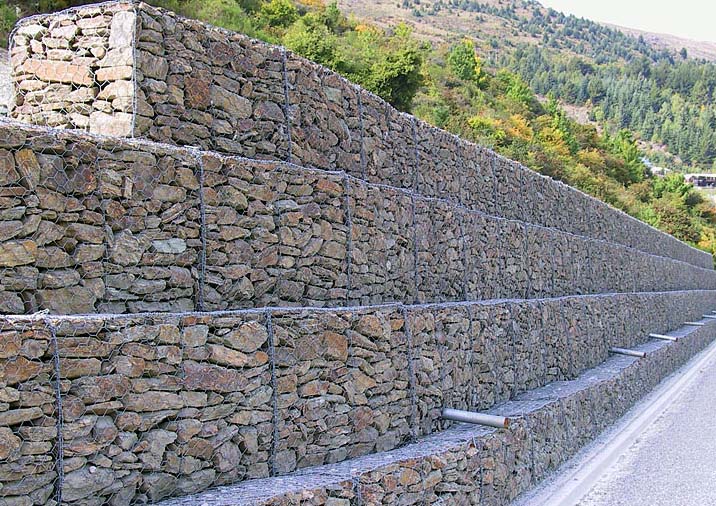
The builders of the pyramids of Caral seemed to understand seismic design in building their structures. They used packaged rocks in bags called shicras made from reeds and or cotton to fill in between the walls of their pyramids. The incarceration of rocks within a restraining mesh or netting is called a gabion. Today instead of marsh reeds civil engineers use gabions to restrain earth movement and erosion along river banks, the seashore, and freeway overpasses.

Present day use of gabions
Shicra bags were filled with rocks, dragged to the building site, and placed
between walls for seismic stability. 
While we were strolling around Caral I asked our guide Miriam if the duality we have seen represented in other early archaeological sites was present in the temples or huacas of Caral. She responded affirmatively that they are found everywhere.  This just seems to be part of the cosmology and religion of   many ancient peoples. The opposites, the dialectic, or duality of things akin to the yin yang of Asian philosophy was a part of pre-Colombian Peru. For awhile we actually had yin yang symbols as part of the decorative features of the Bountiful Temple until one president had them painted over during a semiannual maintenance closing. They are now lunar phases more in keeping with symbols found on the Salt Lake Temple.
The Pyramide Mayor with symbolic stones representing duality.
Our guide pointed to these stones on the first landing of the great pyramid of Caral. These are the light and dark stones on either side fronting the stairs.

My compass indicated the Huanca and the pyramid in the background would
correspond to sunset of the Summer Solstice of December 22 in the Southern
Hemisphere. 


Caral was laid out to the cardinal directions of the compass. Solstices, both winter and summer, are observed from the two meter tall Huanca Stone. This stone aligns with the tops of the two adjacent pyramids.  Other sites probably signaled astronomical events associated with life; planting, harvesting, and the cycle of life.  The ever present spiral carved into stone in Caral and found throughout neolithic Europe and Celtic sites was part of Caral's mythic lore. Discussion continues and likely will not ever be resolved what it meant to early peoples throughout so much of the world.
The spiral is found carved into stone in one of the steps
leading up a staircase of a pyramid. 
Another stone was pointed out to us by our guide and maybe it is a star chart or map.  It does not represent the location of the home world from which ancient astronauts came to carve the images of Nazca.  Most likely it was a reference for astronomical observances relating to the seasons of planting and harvesting. I am waiting for my friend and knowledgeable astronomer Watson to shed light or confirm the stone is something more than a non skid surface. I am voting it illustrates the Pleiades, known as the Seven Sisters, also the emblem of Subaru automobiles.
About one half of the stone that our guide suggested was a star chart. 

The Constellation Pleiades, M45, or the Seven Sisters
Eventually, as has been suggested by scholars, this earliest city of Caral would be abandoned for the more rich agricultural regions to the north. Altogether, the reasons for the rise of Caral in this relatively dry and desert like environment seem incongruous, supporting the validity of the claim for the maritime foundations of the first civilization at Aspero. For the present at least it lays claim to being the first city of the Americas and it is found here in Peru. 

Friday, November 4, 2011

Peru Rocks...

While giving some thought and starting to write this post last week we felt a 6.9 earthquake in the temple. The Peruvians just smiled knowingly as I must have had a bit of a surprised look on my face. We have had two very noticeable earthquakes in the last several months, both in the range 6.9 on the Moment Magnitude Scale. It has replaced the Richter Scale which suffered problems in representing both the accuracy of the power of a quake and quakes at distance from the seismograph station.
Stonework of the Coricancha, the principal temple of the Inca in Cusco.
The earlier quake felt as though the temple were on jello. It kind of shook or jiggled whereas the more recent was pendulum-like.  We could feel the building moving back and forth which was a peculiar sensation.  Peru is a very active seismological area and a part of the Pacific Rim of Fire.  The subduction of the Pacific or Nazca Plate under the SouthAmerican Continent has pushed up the Andes Mountains and is responsible for this seismic activity. The plates move together at the rate of slightly more than 3 inches a year. This could mean that Hawaii is getting closer to Peru accordingly.
Little remains of this once most magnificent Temple of the Sun in Cusco,
now the foundation for a monastery.
We had previously read that no one was killed or injured in these latest quakes, though four years ago in roughly the same area 58,000 homes were destroyed. A report we read this morning notes 500 homes were damaged and another 250 were made uninhabitable. One person lost his life and there were a few injuries. The homes damaged in Pisco and Ica were constructed of adobe. Unreinforced brick and adobe  easily collapse during a seismic event and account for the majority of the fatalities in Peru and other developing countries. Willow and mud construction, known as wattle and daub, retain enough flexibility to resist earthquake loads. We have observed home construction made in this fashion. Later this month we are returning to Caral, the oldest city in the Americas, and contemporary with the first cities to rise in Sumer and Egypt. We will learn more of their ability to construct earthquake resistant pyramids and structures. These structures have stood for 5,000 years but are entirely different than the stone work of the Inca.
The 5,000 year old Piramide Mayor or the Great Pyramid of Caral. Caral is
contemporary with the rise of cities in Sumer and Egypt.
Over the August temple closing we stayed in the resort village of Paracas.  Our hotel was entirely destroyed four years ago and rebuilt. The nearby community of Pisco suffered the most damage. One hundred and fifty of its residents were killed in the city's center when the San Clemente Cathedral collapsed upon them.  They were attending a memorial mass honoring one of their community in addition to observing the ascension of the Virgin Mary. More privation and hardship continued after the quake as government aid efforts were slow in coming. The story reported at the time in USA Today is a very sad one. Local officials were personally attacked by angry citizens looking for, but unable to find, missing loved ones. Reports continue that the displaced and homeless after four years are still existing in tents and temporary shelters.
The Cathedral of San Clemente in Pisco following the 2007 Earthquake.
Only the dome remained standing. 
A very recent report from the BBC notes earthquakes account for almost 60% of all disaster related deaths worldwide in the last decade.  Sadly, the majority of the victims are the young, those least given the opportunity for life's experience.
Note the cornerstones and lintel surviving almost 600 years.
The Inca managed to build structures capable of resisting the earth's violent movements along the western portion of South America.  Without any doubt they were the finest stone masons the world has ever seen and seismically knowledgeable.  As we have begun to learn more about their civilization, they borrowed heavily and depended on the peoples they subjugated for more than just tribute and taxes. Earthquake resistant knowledge predated them by 4,000 years. However, we have not yet found anyone previous to their civilization who worked stone so beautifully. Recreating their building practices and techniques in order to safeguard the residents of Peru today is not feasible. In Ollantaytambo in the Sacred Valley there are Incan built residences which have been continuously occupied for 500 years. That is a world record.
The lintel and doorway of the Incan Imperial Period
The Spanish marveled at the beauty of Incan cities and noted their earthquake resistance. In a seismic event they watched the stones move or dance. In Spanish it is called "el baile de las piedras," the dance of the stones.  At the end of the quaking the stones would return to their set position without damage to the structure.

Adobe mud walls are being washed away at Chan Chan.
What earthquake or conquering conquistador has not destroyed, government and private greed remains a significant threat to Peru's archaeological sites, especially Machu Picchu. Repeatedly, plans are pushed by developers to build heliports, cable car lifts, luxury hotels complete with boutiques and restaurants at Machu Picchu to exploit the majesty and beauty of Peru's most visited tourist site. UNESCO is considering adding it to the List of World Heritage Sites in Danger. We will visit it one more time in February with family coming. Peru has one other site already listed, the Chimor city of Chan Chan, near Trujillo.  It was the largest of any city in the Americas prior to the coming of the Europeans. Estimates range from thirty to sixty thousand inhabitants at its peak. Changing weather patterns bringing rain, in addition to the huaceros or looters, and Peru's earthquakes continue to put it at risk.
A few areas have been rebuilt by archaeologists and under tents to prevent 
further erosion. 

Clockwise, beginning from the Mochica warrior are two
samples of stromatolite fossil. One polished into a sphere.
Basalt from our trip to Chanquillo. It might have been used
to lob down the hill on an attacking enemy. A number of 
these nicely sized rocks exist at the bottom of the hill below
the fortress. Next are porphyry granite polished in an egg 
and carved into the god Aiapaec. Fools gold and a nice
size chunk of volcanic pumice from our visit to Huanchaco
near Trujillo. 
I have collected and purchased a few rocks and specimens as we have traveled.  RA wonders how we will get them home. Among them of special interest to me and maybe a grandson or two at some point are stromatolites, porphyry granite, hematite, and fool's gold. A rendering of the principal deity of the Mochica culture Aiapaec carved from porphyry granite is part of the collection. This distinctive red granite is rich in copper and molybdenum. It is found from the seacoasts of Peru to the height of the Andes.  It polishes very nicely and was prized in other parts of world including ancient Egypt. Napoleon sent an unsuccessful expedition searching for an Egyptian outcropping of porphyry granite. It is also found in the Hagia Sofia of Istanbul being fashioned by the Byzantine Greeks a thousand years before Napolean. 
Monoliths from the unfinished Temple of the Sun in Ollantaytambo. These
and other stones were carved from porphyry granite. 
Entrance way to the Temple of the Sun. The stone work is
magnificent. 
The Inca carved this very hard stone and had begun construction with it for this temple. The quarry was some distance from their final resting place. Scholars are unsure why the temple was abandoned. Maybe it was due to the arrival of the conquistadores, the civil war between Huascar and his brother Atahualpa, or the diseases which preceded the physical arrival of the Spanish in the Andes.   
Not exactly a transit but my compass reads 58° NE, pointing toward the 
solstice sunrise. It rests upon porphyry granite. 
I placed my IPhone digital compass on maybe an altar in the temple. It is aimed toward the face carved high in the cliff. It marks the sunrise of the Summer Solstice on December 22 in Ollantaytambo.
The Inca carved a face of their emperor circled in this image to which my
digital compass in pointed. 
The Inca face carved into the cliff wall. Archaeoastronomy, solar or
celestial alignments are prevalent in every site we have visited in Peru.
Josh and Mary enjoying the view from the Temple of the Sun
Porphyry granite dates to the proterozoic age of nearly two and a half billion years ago. Maybe this was during the third day of creation as the waters separated from the dry land. Also on the third day were the grasses, the herb yielding seed and tree bearing fruit. On the fourth day, in order to give rise to the creatures of the sea and subsequent mammals, small multi cell cyanobacteria or blue green algae had to do the heavy lifting of converting the earth's carbon dioxide rich atmosphere into breathable oxygen. These fossilized remains known as stromatolites are perhaps the earliest of all living things. They date to this same proterozoic era beginning about 2.5 billion years ago. These fossils are found on the Chilean border in the district of Tacna, not far from the world famous Nazca Lines. I found mine at a rock shop in downtown Lima on a previous trip with our friend Cesar. 
More porphyry and basalt on the Islas Ballestas near Paracas. These islands are
known as Peru's equivalent of the Galapagos Islands. We did not see any iguanas
however, just thousands of birds, sea lions, and a few warm water penguins. 
Red granite sands at a beach in Paracas

The stones of Sacsayhuaman above Cusco.
Among the Inca and their antecedents rocks had special powers attached to them and were known as huacas. They might be the personage of an ancestor or other important cultural figure turned to stone by the gods. Mountain tops as well as man made structures were included as huacas. My rocks or huacas are reminders of our visits in this most incredible country. 
The Intihuatana Stone, the most famous in all of Peru. It will cast no shadow
next week on on November 11 when the sun is at mid day. 
With the Spanish conquest of Peru the stone work of the Inca ceased and in many cases the temples, buildings and shrines were torn down and or destroyed as they impeded religious conversion and change. The stones in these most beautiful in all of the world buildings, those that were not too large, were carried off by the Europeans to construct their New Spain. Sacsayhuaman, the magnificent fortress and religious site of the Inca above Cusco, is only a shadow of what is once was.  The stones still in place are those simply too large and beyond the capacity of the colonists to haul away. Fortunately, as all can attest who have seen it, the world is grateful Machu Picchu was mostly left to the embrace of encroaching vegetation and overgrowth for 500 years. Had it been found it too certainly would have been destroyed.
Temple of the Sun in Machu Picchu reminiscent of Coricancha in Cusco
No mortar was ever used in these stone structures and personal inspection confirms not a knife blade or even a piece of paper can be inserted between the stones. All the more impressive since the largest stones at Sacsayhuaman weigh upwards of 200 tons. 
Grandson Josh at Sacsayhuaman in August of this year.
One has to wonder if the children and grandchildren of the Inca might have considered the subsequent tremblers as churches, colonial mansions, and viceroyalty offices were leveled in quakes. Major earthquakes occurred in 1586, 1604, 1619, 1687, 1725, 1746, 1865, 1868, and throughout the 20th century. A major quake above 7 on the MMS scale occurs in Peru every hundred years.  Lima was last severely hit last in 1974. The accompanying tsunami and flooding in the Port of Callao caused significant property damage and death. 

The young Prince Siddartha might well have made his observation about the Noble Truth of Suffering had he had visited Peru. The noble truth of suffering as I understand is: "Birth is suffering, aging is suffering, illness is suffering, death is suffering, sorrow, lamentation, pain, grief and despair..." 

We continue to admire the people we have met here, their past, the beauty of their country and this privilege of working amongst them. They have endured and accomplished so much. We look forward to February when additional family will visit. 
Another example of the magnificent stone work at Machu Picchu
Mary at the Sungate along the Inca Trail. Machu Picchu in the distance.

This post is for you Mary. We are happy we could share it and Peru with you.

With much love!

Dad


Tuesday, October 11, 2011

Human Sacrifice, Max Hall, 6,000 Years of Habitation, and Cuy Curing Cancer...

Peru has its equivalent of the National Enquirer in this newspaper cover we photoed on our recent trip to Trujillo. The sub headline reads, "Medical Science in the United States has found that an Enzyme in Guinea Pig Meat Shrinks Tumors." We have enjoyed very good cuy in Peru and some pretty mediocre plates too. A number of variety of foods and beverages are promoted for their various health benefits just as they are stateside. In traditional medicine of the Andes cuy were used and still are in the diagnosis of ailments by shamanistic healers.  We will continue to enjoy cuy from time to time, but not necessarily for its anti-cancer properties. Presently, we are arranging a 'cuy night' at our local favorite restaurant in La Molina for the other Norte Americanos who have never experienced it.
Do you suppose the Cuy Growers Association of  Peru was
behind this to get us all to eat more meat? 
In our recent trip to Trujillo we visited the Huacas del Sol, de la Luna and El Brujo. In the distance from the Huaca del Brujo we could see the Huaca la Prieta. This is a very old site, pre-ceramic, but not open to tourists. The middens or garbage dumps at this earliest site of la Prieta have interesting clues as to what early life was like on the north coast of ancient Peru. Cotton, likely native to the area, had been woven into fishing nets with the use of gourds and rocks for floats and anchors.  Remnants of crustaceans, marine creatures, and primitive stone tools have been recovered, but no projectile points. A number of new world archaeologists suggest these earliest coastal inhabitants came from the Amazon basin, crossing the Andes from the headwaters of the Amazon River.
RA's recent efforts in producing wonderful yuca based cookies. On the 
left are a cheese and butter containing variety. The others are a raisin
or oatmeal equivalent but without the oatmeal. They also contain 
kiwicha which is a popcorn popped quinoa seed. 
It is also believed from the Amazon came the yuca so widely used throughout the world today. It is also known as manioc and cassava. It is third in the world in the supply of carbohydrates as a food source. I am guessing rice is first in the world and potatoes are second. Tapioca is extracted from this yuca tuber. The question now is can we grown this in our garden in Utah when we return home? Yuca is served with nearly every meal in Peru, though our upstairs neighbor, the first counselor in the temple presidency, refers to it as "yuck-a." The Brazilians may have the best recipe for yuca or tapioca, though RA's cookies are wonderful, both types especially as they are hot from baking in the oven.  In my life I have discovered almost anything vegetable in form, swimming with real butter, a little salt and pepper is  good. The Brasileros make a tortilla from the yuca flour, fry it and while cooking sprinkle on cocoanut, banana slices, and chocolate. We have found very good yuca which is softer, maybe due to its freshness and also yuca that has about the same texture as a tree branch. Our new friend Walter, a taxi driver we met in Trujillo sent us a care package with very fresh yuca along with aji and papas, (peppers and potatoes.)  Walter is going to take us to Chiclayo and Cajamarca on our next trip to Trujillo. We would like to go back next month as soon as we know what our schedules will be in the Temple.
The very fresh yuca Walter sent is at the bottom of this
image.  He also sent two kinds of peppers that we enjoy, 
a new one called aji mochero and aji rocoto alsong with
new can chan potatoes.
Also found in these middens of the pre ceramic cultures of northern Peru have been the skins and remnants of the San Pedro cactus which grows abundantly in South America from Ecuador to Chile. It too plays and important role in traditional medicine by the shamans.  The Cusco area of Peru receives a number of young American and European tourists seeking spiritual cures or just a good high and they will visit a shaman. In addition they want to experience the power emanating from the Intihuatana Stone or other huacas that were and are important to the Inca and their predecessors. Spiritual experiences with a shaman centers around a brew or soup made from the San Pedro Cactus. It contains among other things a mescaline hallucinogen.  Traditional medicine has often been the source for genuine medical discovery and investigation. The San Pedro Cactus possesses a compound that inhibits growth and destroys a number of varieties of penicillin resistant staphylococcus.
A San Pedro Cactus next to the table where we dined in
Huanchaco, the beach city of Trujillo. It gets its name
because Saint Peter holds the keys to heaven and the 
extract of this cactus allows the shaman and his clientele
to visit heaven. 
Huaca al la Prieta is one of the earliest sites on the North Coast, dating to
about 3500 BCE. In the foreground is a field of sugar cane, not native to Peru. 
The site at El Brujo and la Prieta encompass 6,000 years of archaeological history from the earliest cultures of the area who initiated settlements through the conquest of the Chimor civilization by the Inca. It is a huge if not impossible challenge for scientists to piece together these bits of flotsam and jetsam of the past to construct the lives and activities of the former inhabitants. A written language seems to have been absent for long stretches of pre-Spanish Peru so we don't have readily accessed accounts of events in the lives of its former inhabitants. Quipu or Khipu is the very strange and complicated system of recording and conveying information. Cotton cords and knots along with alpaca wool and other fibers of varying colors were twisted into yarns and tied together in sequences that still escape the best efforts of linguists aided by complex computer programs to unravel their secrets.  Quipus were used by Andean peoples as early as these very first civilizations and found in Caral, about 3000 BCE, where we visited earlier this year. Quipu or knots tied in strings were also used by early Chinese chroniclers and other peoples as well. So far they have largely escaped decoding. A professor at Harvard, Gary Urton, is leading the effort to decode this strange record keeping medium. It is known as the Khipu Database Project. 
The knots and cords correspond to a binary system of numbers.
It is speculated that a sequence of knots and cords could be tied
together giving the number 84014, a zip code, which would mean
Centerville Utah, USA. 
Following this earliest culture who built La Prieta were the Moche. They were the first to incorporate urban construction around ceremonial centers, huacas and temples. An important component in the fabric of their religious life and society was human sacrifice.  A number of friezes have been uncovered being very well preserved showing captive after captive being lead to the place of sacrifice. Human bones found in areas adjacent to these huacas show signs of freshly broken bones that had begun to knit back together. Injuries consistent with armed combat and warfare. Skulls have been studied too with evidence of blunt force trauma, being bashed in with stone or metal club. From the friezes and studies by the archaeologists there seems to have been quite an elaborate ritual surrounding this ceremony of human sacrifice. It involved ritual or real combat in which the 'loser' or victim was a warrior who lost his hat or helmet in the combat. Imagine Max Hall, the despised former BYU QB playing at Utah. If someone knocked off his helmet instead of becoming a sacrificial victim the home team would be awarded an extra 10 points. It would have to be a one time in a game score as his head would be literally knocked off during the course of an entire game. His captured helmet could then be displayed in the trophy cabinet at the Huntsman Center.
Max Hall did have a cool helmet. Do the Coogs have better helmets than the Utes?
In Mochica society this unfortunate or fortunate victim, depending on whose perspective, would be treated royally and administered the San Pedro Cactus soup just prior to his ritualistic execution. Scientists have pieced together evidence from the friezes suggesting the victim would be bathed and given a drink of a hallucinogenic cactus. Today the shaman accompany their San Pedro cactus brew with tobacco smoking or a strong shot of tobacco and honey juice up the nose. Coca leaves were also part of the apothecary of ancient Peru. Remnants of coca plants have been found in these earliest sites through the Mochica period and to the Inca. By the time the sacrificial victim was lead or carried to the place of execution he was in a trance like and euphoric state. Whether he would be bopped on the head, have his throat cut or both, it was not clear from our guide. If his throat was cut his blood would be collected and presented to the chief Mochica sitting on his platform overseeing the entire ceremony. His body would be thrown over the side and tumble into a waiting grave area. A Peruvian archaeologist associated with a university in Lima, among others, has written about the role of sacrifice among the Moche. He observed: "The sacrifice of warriors seems to have had as its objective to choose candidates for the sacrifice among the most productive members of society. From the viewpoint of society, the sacrifice is the offering of one of its most valuable goods, while it shows unmistakably to all the state's right to exert violence and govern human life. The Mochica drawings seemingly tell us that the gods, represented by the warrior priests in the ceremonies, give life and therefore can take it away."
Sacrificial victims tied together on their way to execution. The genitals
 received special emphasis in the friezes suggesting their importance as
sacrificial victims in terms of their virility and strength. 
A fine line drawing taken from a Mochica ceramic pot. Naked victims
are being lead and carrying others to the stand where the chief sits
waiting to drink the blood of the victims.  Below the line are the dead
in the underworld. Note the ever present serpent.  This serpent was
recently unearthed along with carved stone birds in Southern Turkey
at a site known as Gobekle Tepe. That site is at least 11,000 years old.
A quick review of the cultures of the world on Wiki suggests human sacrifice was an integral part of nearly everyone's history. None seem to have been immune from it. This notion of pleasing the gods, insuring a successful harvest, bringing much needed rains, or the scapegoating of societies' shortcomings by attaching them to one or more victims of sacrifice was a common practice. From the witch trials of Salem Massachusetts, one could argue that human sacrifice is a thread in the tapestry of American history. This is a thread that lingers with us today, some would say, in state sanctioned executions, and assassinations of Muslim American US citizens living in the Middle East.
A painting of an examination of a witch from the Salem period. 
We continue to be fascinated by the history, the past, and the present of Peru. We make new friends and we experience life here a little differently. The things we see are troubling, the past is uncomfortable, and the present is often challenging.  We observe present day Peruvians and we see incredible persistence and perseverance in dealing with their obstacles in life.  We observe their faithfulness in pursuing their religious beliefs and dreams, whether it is coming to the Lima Temple, celebrating the groundbreaking of the Trujillo Temple or petitioning a Saint for intercession in one of the beautiful downtown cathedrals. I have found it comfortable to be in a Shinto Shrine of Japan or an Ottoman era Mosque of Istanbul. Likewise, it was a pleasant experience recently observing a midday Mass at the Church of Merced in Lima.
Church of the Merced built in the early 17th Century of 
imported granite from Panama. 
We add our prayers to those supplicants who seek redress, relief from pain, the privation, and the hardship of present day Peru. We love the people we have met and serve here for a time. We respect and appreciate their past, so rich in accomplishment and sacrifice.
The Huaca El Brujo or the shaman.  It is partially covered to protect recently
uncovered friezes from the sea air and scarce rains.  This huaca and others
was still being used by local shamans until near recent times for its power, 
both in healing and visionary potential. 

A frieze depicting the Mochica god Ayepec. Serpents seem to play and
important iconographic role associated with deities in the Americas. Note 
also the feline jaguar teeth. Both the serpent and the jaguar were important
symbols for the Inca a thousand years after the Moche people.