Favorite recent and insightful quote I have read recently:

Favorite quote I have recently read: "The word temple comes from the Latin templum, which signifies an extended open space that has been marked out for the observation of the sky. In what manner is such a space marked out? According to Dr. Hugh Nibley, the word templum, "designates a building specifically designed for interpreting signs in the heavens--a sort of observatory where one gets one's bearings on the universe." The root "tem-" in Greek and Latin denotes a "cutting" or intersection of two lines at right angles, the point where the "cardo" and "decumanus" cross, hence where the four regions come together." Matthew Brown - "The Gate of Heaven"

Thursday, June 2, 2011

Mini Sandias y Algodon Peruano (Peruvian Cotton)

We have been walking to, and visiting, several newly discovered stores not far from our apartment. One is called Vivanda and is known for having things other stores do not stock. It is more upscale than our local Tottus. We have found incredible mandarins, very large imported US navel oranges, Snickers bars, Godiva chocolate, M&M's, and even Fruit Loops.  In addition they have a wonderful bakery section though our dieting at present has kept us from sampling any of those treats.
Clockwise the store at night, the chocolate candy counter next to check out,
The bakery section and one of the wonderful cakes we'll try at the next party.
Corn Flakes and other American cereals. RA is filling a bag with mandarins.
They have a large section and variety of cheeses including yellow cheddar
and gouda which is sometimes more difficult to find.
Fresh vegetables fill the shelves and we have brought home something new to try. Being in Peru is about trying many new things. These small vegetables are called 'Mini Sandia' and are not native to Peru. They may have originated in Central America and Mexico and can be grown in the US and seeds are sold in many garden centers. They will end up on a vegetable tray RA is preparing for a Saturday afternoon get together with the upstairs neighbors and the other Norte Americano Missionaries from the Temple and Area Office.  However, they may end up with our scrambled eggs along with onions, tomatoes and shrooms that Adam does not like. The Mini Sandias can be put into salads, salsas, pickled like gherkins, and are reportedly "terrific in stir fries."  They are also known an 'mouse melons' among other names. These little fruits can be found at farmer's markets and are grown as heirloom vegetables.  It is about a 2 mile walk to Vivanda and we plan on walking there at least once a week. We leave in the morning, complete our shopping, and then ride back in a taxi with our groceries.
The Mini Sandia or Mouse Melons washed in Chlorox water
and rinsed for eating
The other stores we have found are in a neighboring community of Ate. Among them is clothing store called Creditex.  It is an outlet for an upscale Peruvian shirt and clothing manufacturer.  Unlike most every other store we have visited in Lima they have sizes to accommodate North Americans. Several New York clothing brands are represented along with Cutter and Buck and Cabelas. Prices have been very attractive. I have bought several of the aforementioned shirts from $3.00 to $13.00 each. They favorably compare to online prices in America from $65.00 to $105.00. Since we have been in Peru I have been looking for a source of Peruvian Pima Cotton shirts, deemed to be among the very best in the world.
The outlet store for Cutter and Buck clothing, Cabelas and other shirt makers.
The insert was a twill 100% Pima Cotton soft as silk shirt I bought for $13.00
This Peruvian Cotton just known as Pima Cotton in many other parts of the world compares to very fine Egyptian Cotton. After the arrival of the Europeans, cotton seeds from Peru were taken to the Caribbean where it would dominate local agricultural production and worked together with tobacco to encourage the British to increase the slave trade bringing workers from Africa. From the Caribbean cotton moved to the Carolinas and gave rise to Sea Island Cotton bringing slavery and the attendant human suffering to North America.
Apparently Peruvian Pima Cotton is still picked by hand which preserves
fibers and assures its softness.
In the early 1900's cotton seeds from Peru were planted in AZ and raised by Pima Indians working with the USDA, hence its name.  In the North of Peru and coastal regions of Ecuador cotton balls have been traced back by archaeologists to 4400 BCE. The fibers of this cotton are up to 40% longer and softer giving it a more silk like feel.  Cotton was used by the maritime cultures in Peru 6,000 to 7,000 years ago in making fish nets in addition to clothing and the recording and accounting system of mysterious writing system known as Quipu where different colors of cotton strings were tied together and branched apparently storing enormous amounts of information. There is to date no record of any other written language in pre-Columbian Peru.
Mostly cotton threads, not wool, were used in the making of this quipu.
Scholars and archaeologists have not deciphered this mysterious recording medium
Peru continues to be an impressive country for us with so much in natural resource, history, and potential.  It remains one of the very fastest growing economies in the world, only second to China last year. We await the results of the election this Sunday to see which way it will go in the future. It is an important election with two very clear alternatives for voters. A number of Peruvians believe one candidate, a former military commander and supporter of Venezuela's Hugh Chavez, will enact constitutional decrees to allow more than one term, essentially becoming a dictator. The other is the daughter of imprisoned Alberto Fujimori. The business community is largely behind Keiko Fujimori. There are concerns for the maintenance of the free market economy and continuation of international agreements and businesses in Peru.

We are not going anywhere this weekend as the Temple is closed in the afternoon on Saturday and no church meetings on Sunday's election day. We will continue our walks this weekend and discovery of things to do in our world in Lima Peru.

Sunday, May 22, 2011

The "Real' Peru and Extracto de Rana

Last Monday a friend invited us to his world where he works and operates two stores in a shopping district called 'Gamarra.' It is the largest textile market in Peru and I confess I have never seen anything like it anywhere.  It is a labyrinth of shops in one very large block with stores selling everything imaginable related to clothing and textiles. Previously I had bought a number casual shirts very inexpensively in Gamarra. He supplies textiles to shirt makers and has a huge inventory of fabric so he does not deal with the public directly. He works Saturdays in the Temple, some days as long as 14 hours keeping the Bautisterio running and functioning smoothly. He does this each week. 

It is relatively safe in Gamarra, but none of us Norte Americanos ever venture there in the afternoons and we are always are out of there early in the day.  Security police and cameras are everywhere, but you do observe some rules. We had a fine lunch at one of our friend's favorites and then he wanted to show us the 'real' Peru. We had no idea what he was talking about or where we were going. He assured us it was very close.
Monday mornings are not very crowded and it is a good time
and day to visit though some stores were not open. 
It is called La Parada and is contiguous to Gamarra. Our friend explained we would need to remove our watches and make certain our wallets were secure. We have since discovered it was not a good idea to take a camera there either, but I did.  He was continually looking behind and around us to observe if anyone was following us at anytime. That is one of the indicators that you are about to be mugged or robbed in Peru. As we entered, our friend turned his back pack around and wore it frontwards, a not uncommon practice. Street gangs and other criminals also make La Parada home. Stolen goods are fenced there including cell phones, we were told, that still have all the previous owners contacts and numbers.
One of many narrow aisles selling fruits and vegetables at
extremely low prices.
We have observed we live in a bubble here in our La Molina neighborhood next to the Temple. People are relatively prosperous and life by comparison to many other parts of Peru is easy. Among the nearly 30 million of Peru's population, government agencies suggest less than 40% of the population is in the 'poor' or 'very poor' category. Both the US State Department and the CIA put that number at 54%. Being poor can mean many things. In Peru it means basic inability to afford human needs such as clean water, sanitation, electricity, security, health care, education, adequate nutrition, clothing and shelter.  "Houses" made of sheets of woven together bamboo strips that neither keep the cold out or the heat in, surround far too many families along Peru's coastal areas.  They exist without windows and doors and roofs that will keep out the mist or very scare rainfall. More upscale structures have plastic sheeting over the roofs but they are not common. The several recent elected governments have tried to solve social problems with programs, but mostly we have been told, they are ineffective and have been largely aimed at gaining voter support with little long term impact in improving the status quo.


 RA did buy a 1/4 kilo or dried oregano, about two quarts worth.
That is a lot of spice. It was the smallest quantity they would sell.


Bees were working and building their hive in one of the stalls. We were
given samples  of the honey comb and bee pollen. I did read that pollen
contains a a number of kinds of bacteria and mold so we later disposed
of the the bottle we purchased. 
There is a great disparity and gulf between the 'have's and 'have nots.' The 'have nots' are pushing hard for social and political change with the federal elections coming this June 5th. The poor have been poor and remain to the present, though the last few democratically elected presidents take credit for reducing the numbers of those below the poverty level.
Bags of coca leaves for sale.  It is used in making a tea
and was recommended to us when we visited Cusco and
Machu Picchu.


We were hoping to travel over the election weekend but with the potential for civil unrest or upset we will stay home.  The Temple will be closed a half day on Saturday the 4th for the election on June 5th. It is mandatory that all adults vote in every election lest they pay a fine.  In order to accommodate the travel required to return home it was decided to close the Temple early. We were also told by friends to store extra groceries because of the possibility for strikes, unrest, and road blockages.
Aluminum cookware is also to be found in La Parada
Our travels have been limited in Peru thus far, but the contrast between where we live and what we have seen outside of these wealthier areas of Lima is troubling. Near our apartment is a very nice version of a Target type grocery, appliance, electronics, and clothing store called Tottus, a far different shopping experience than we found in La Parada or Gamarra.
An open top bag of bee pollen being reclaimed by a few bees.
The elections next month will be important for the present and future of Peru. The huge support for the leading and left wing vote getter in the primary elections from the poorer areas of this country should send a powerful message to those in power. Ignore the poor and very poor and solutions may not always be as peaceful as the electoral process of the ballot box. No one wants to see the chaos, unrest, terror and murders Peru suffered for decades at the hands of the Sendero Luminoso or 'Shining Path' as they were called. 
We intended to purchase some citrus in La Parada. We love
the mandarin oranges and tangerines in Peru. They too were
about one third of our neighborhood grocery store.
We appreciate our friend for having confidence in us and showing us a part of Lima we had never seen. Likely, we will not return to La Parada. It was fascinating place and we are glad we ventured to the 'real' Peru. In many ways it reminded us of the bazaars we had visited in Istanbul Turkiye many years ago. 
Live frogs and toads are kept in several booths we passed.
The purpose is to consume these in a 'health' drink called
extracto de rana.

The Osterizer is going and mixing up the extract of frog. To it are added
additional items such as maca powder, honey and malt. It is said to have
near magical restorative and health benefits. Several You Tube videos
and some research suggests the frog or toad is not cooked but it is
skinned, gutted and then tossed into the blender. 
Main Street in La Parada. The red onions on the right are
for sale for 1 Sole or about 37 cents per kilogram. That
is about 16 cents per pound.


Sunday, May 8, 2011

Our friends Lucho, Negra, and our Democratic Pigeons

On our walks to various places including the Temple we have been making a few friends. Early in the mornings the local pigeons will see us coming from a block away and fly from their roof top perch and land at our feet. If we do not bring enough crackers for them they will walk behind us for a ways begging for more.  The first counselor and his wife, our neighbors upstairs, also walk the same route. He is a Republican and one of his goals has been to "kick" one of our friendly pigeons. We are trying to train them to buzz the president and leave something fresh on his suit jacket. We'll let you know if we succeed. We have warned him they are Obama pigeons and he should be more respectful.
We only see our pigeons early in the mornings, though sometimes on
our afternoon shift one of them will still be in the neighborhood.
Also on our walks to the one of several shopping plazas, Golds Gym, and the barbershop we pass a neighborhood 'watch-ee-man'. That is the term the Peruvians use for their ever present local security guards. We have become friends with him along with his dog Negra. Often Negra would be sleeping in her house until we became friends a few weeks ago. Now at the sound of our voices she will come running.  She knows we have treats for her. These include burgers from Peru's finest, a place called Bembo's. Lucho, the security man, carries no weapons, no Mace, no radio, not even a whistle like the guy in front of our apartment. He looks after a preschool on his street. Maybe the kids like Negra too. The guy in front of our apartment, at least has an official looking vest and uniform along with his whistle. Just about every neighborhood in La Molina has a 'watch-ee-man.' They are common throughout Lima in the middle and upper scale neighborhoods. We pay a monthly fee to the security company for our around the clock 24/7 security of 70 soles or about $27.00 per month. All of the other tenants and owners on our street pay similar fees.
When Bembos was closed one morning, too early, we stopped by
this local family operation and had the cook make a couple deluxe
burgers for our friends. She was pleased to have her picture taken.
RA has cooked some soup bones we bought from the local Tottus store for Negra as an alternative to the double burgers and chicken sandwiches we have given her in the past. We try to walk a few miles almost daily and choose a route that will take us by Lucho and Negra every several days. Tomorrow it is time once again to visit them as we likely will walk to Jockey Plaza and back and that is about six miles.  Negra has to be restrained or she would follow us home. Of course if she is wolfing down a double burger with the works she lets us walk away.
Lucho and Negra "on duty"
Lucho has become quite emotional on our last several visits. I suppose he thinks it odd that a couple of Americanos would care about him or his dog. He has had tears in his eyes as we have brought him treats.  He told us he "thanks God that we would care about him and his dog." We will find other ways to help him as we get to know him better. These security men make very little money so I know he does not have much. It is common for apartment owners to give a little something to their local 'watch-ee-man' but Lucho and his dog are more than a half mile away from us. We give our local guys treats from the local coffee shop, muffins, and chicha which they appreciate.
Negra did not want to hold still as those deluxe burgers
were in the bag and she knew it. 
We use our limited language skills to talk to Lucho and also Spanish commands for Negra. We will learn more about them as we become better friends. There are a lot of very poor areas on the outskirts of Lima and he likely must travel some distance to get to his neighborhood where he looks after things. There are many things we like about life here in Lima Peru. Making friends with Lucho and his dog Negra has been one of them.
She loves a little attention

Thursday, April 28, 2011

The Oldest Solar Observatory in the Americas...

We are trying to work out a weekend adventure to get to Chanquillo, also spelled Chankillo. It is north of us on the Peruvian coastal desert plain and is on the way to Chimbote. A few years ago a Yale University archaeologist  from Peru began seriously investigating the site, not for its astronomical significance, but for a very well constructed fortress. For decades, even centuries, no one understood what the 13 stone towers across the top of a prominent hill meant or were used for by the ancients. The scientist who solved the puzzle of the 13 towers is Ivan Ghezzi. Many of his papers are available in PDF format on web.
The 13 stone towers of  Chanquillo
Photos courtesy of Ivan Ghezzi
Since we had visited Caral our interest in archaeoastronomy in Peru has been piqued to some degree. Archaeoastronomy has been defined as the study of beliefs and practices relating to the sky in the past, especially in prehistory, and the uses to which ancient people's knowledge of the skies was utilized.
Sunrise of the Winter Solstice in June 
Chanquillo dates to the 4th Century BC. Archaeologist, Ivan Ghezzi, noted that "research in Peru is constantly pushing back the origins of civilization in the Americas. In this case the complete solar observatory at Chanquillo is the earliest such structure identified." It predates the Mayan observatories by 500 years and the Inca by 1700 years. The peoples who constructed both the solar observatory and the nearby fortress have not been identified as of yet. They predate the Moche/Chimu and followed the Norte Chico. Unlike Caral stone weapons have been recovered from the site. The 13 stone towers gave the locals accurate dates throughout the year within a two or three day accuracy and told them the dates for the summer, winter solstices and the equinox.  That was sufficient for them to plant their crops and to know when other important ceremonial observances should take place.
The hill of the 13 stone towers with the added artist's demarcation. A similar
observatory is opposite the hill for the sunset.
A film crew from the BBC with narrator Brian Cox has visited the site and filmed the rising sun at Chanquillo. The video can be viewed with Professor Cox's narrative at this BBC site for science and the environment. 
The fortress
Chanquillo, in addition to the fortress, includes a large ceremonial center. Altogether it  covers almost a square mile. Its 13 stone towers stretching a thousand feet across the hilltop draws visitors to the site.  Maybe we can watch and video a sunset. Dr. Ghezzi concluded the fortress was likely used for ceremonial purposes, rather than for valley defenses for a number of reasons.
The 13 solar towers as seen from the fortress
Today we confirmed the names of three different tour operators and guides that might be willing to take us there. Our next post about Chanquillo will have our own photos and images from the site.

Sunday, April 17, 2011

Caral -- The Oldest City in the Americas

Because of the Peruvian Federal elections the temple was closed on Saturday so we traveled north of Lima for a little more than three hours along the Pan American Highway to our destination of Caral.  We hired Pedro, one of our two favorite taxi drivers for the day. His wife Carmen Rose came along also.  We took almost twelve hours of their day. They speak no English, so it was a nice opportunity to visit as best we could and exhaust our limited vocabularies. RA prepared a great picnic lunch we enjoyed with them.

GF, Pedro, Carmen and RA in front of the Great Pyramid 
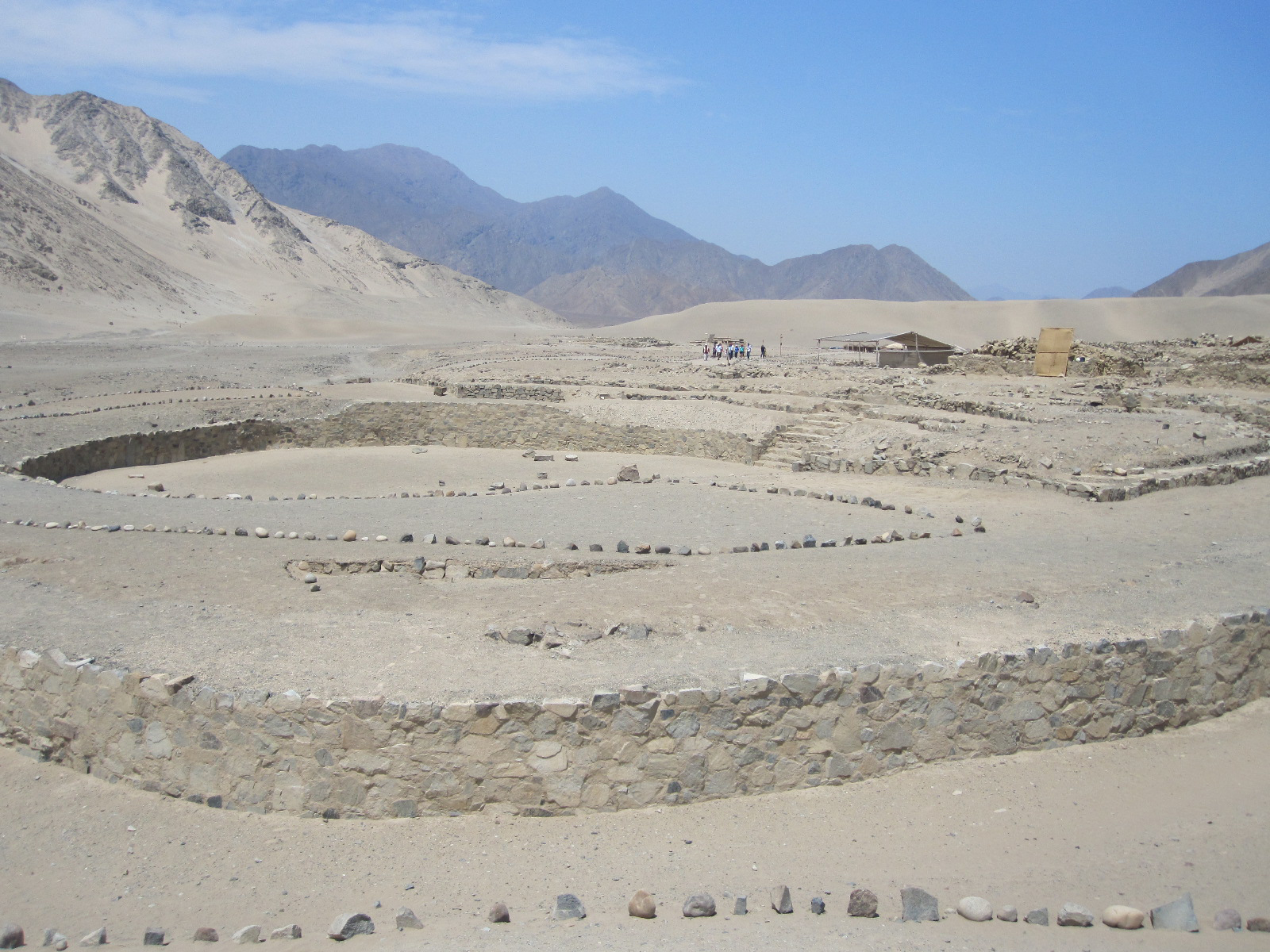
There are a number of ruins collectively known as the Caral Supe. It flourished in this Supe River Valley between 5,000 and 4,000 BCE, making it the oldest city in the Americas, thus making it contemporary with the Egyptian Pyramids and the city of Sumer in Mesopotamia. Archaeologists suggest it is one of 30 major population centers of the north central coastal area of Peru of the Norte Chico culture. This civilization was pre-ceramic, meaning no fired pots only carved stone plates along with sunbaked pots and kitchen ware. The society was advanced in many ways  including extensive canal building and irrigation from the Supe River. The area along the river is still farmed today but otherwise it is a very dry and arid place.
Peppers, corn, potatoes and a number of other crops are still farmed today
Estimates are that Caral existed for a thousand years and at its high had a population of 3,000.  Climate change today is eroding a very large dune behind one of the major pyramids exposing ancient burial sites.

The dune in the background is being eroded after 5,000 years

Archaeologists believe the Caral was organized as a huge calendar. Every public building, pyramid, and temple was constructed as homage to a particular deity and each "respects a specific astral position."
The Large Amphitheater
We were shown this carved granite stone with a number of pock marks on it as the entrance of one pyramid that I assumed were just for "non skid" purposes. Our guide book suggests it was a star chart and associated with the activities of observation from the pyramid. Next time we are there maybe I can find Pleiades on this Caral stone star chart. It was an important constellation for ancient peoples in recognizing both the vernal and autumnal equinox. 
The stone with the star chart is closest at the bottom of the photo
Feline forms are constructed into the pyramids, the origination for the much later Incan use of the jaguar. Birds and serpents are also found in the form of stone petroglyphs and carvings. The three symbols of existence for the Inca and Caral were the serpent which represents the underworld or death, while the jaguar is our present existence and the condor or bird represents the future life. We were not allowed into the pyramidal structures to photograph these feline forms and more. Petroglyphs are common in Caral. The ubiquitous and mysterious spiral is found here as many other ancient cultures including the Anasazi of the Southwest US. It seems it was important to the Celtic peoples as well. 

Spiral carved into granite near one of the pyramids.
Oddly, very few weapons have recovered from these sites suggesting to those who know that it was a very peaceful society.  They thrived for approximately a thousand years, but then began moving north to more fertile areas but still extensively used irrigation from rivers to grow their crops. A number of musical instruments have been recovered suggesting music was a very important part of the Caral society. These consisted of flutes and recorders, made from bone, clay, and stone.
Sculture of a male surviving these many millennia
Of significant interest to us were the evidences of archaeoastronomy in Caral. A stone monolith of some 2 meter in height called "La Huanca" was uncovered and connects it with the adjacent Galeria and Huanca Pyramids. It happens the angle of the stone to the tops of the pyramids marks the location of the summer and winter solstices of about 40+ degrees. I have looked for additional information about this angle but have found little so far.

The Huanca stone aligns with the tops of these two pyramids
Also of interest are the temple symbols we found both in Caral and in Machu Picchu. The quadrature of the circle remains a part of many civilizations it seems. Several squares with circles exist in Caral as they are found in our Temple in Bountiful, here in the Lima Temple, and many others. Brother Nibley and others have written about the meaning of the square and the circle in temple worship.
A circular enclosed area inside a square with the accompanying notation that
 it was designed to admit one person at at time
Note the square and the circle of this temple pyramid. This photo was borrowed from a
a book on Caral we purchased in Lima. 
In the residence portion of Caral we noticed this "Inca" looking door construction and found it interesting.  According to our guides at Machu Picchu this shaped door has greater strength in resisting earthquakes so common in the western portion of South America.
Note the doorway or window in the almost tumbled down wall
We want to go back again to Caral as we missed a number of sites within the city ruins including more petroglyphs and temples. 14 miles from Caral on the coast at the mouth of the Supe River is another set of ruins we did not take time to visit.  We have been told by friends the beach and coast, with tide pools and sea life is not unlike La Jolla CA.
*A petroglyph of quipu, a type of ancient writing system continuing
to the Inca where it was lost with the arrival of the conquistadores
Peru remains a fascinating place with an incredible history and great natural resources. The people are industrious and talented. They work very hard to live and exist, especially those outside of immediate prosperous neighborhoods of Lima where we are. The people sent a strong message to the government this past week on election day. The left leaning socialist candidate received a majority of the vote.  A runoff will happen in the next month to determine the direction the country will go.  It seems the theory of trickle down economics  practiced by Peru's recent leadership has benefited a few, but not enough for all the people.

*A post on quipu or the Inca and Caral writing system will happen on another date.


Monday, March 28, 2011

Chile Debe Devolver El Huáscar...

This past week we were treated to a walking tour of old Lima by our friends the Andersons.  They are extremely knowledgeable about Lima, its past and present.  We visited several colonial era homes, or maybe mansions would be a better term including that of Admiral Grau, as well as a beautiful 18th Century Cathedral. We took a few photos to share. Inside the Cathedral of the Virgin de Mercedes, simply known as the Merced Church, there were warnings about not using your cell phone but no proscriptions against photography. The Virgin Mercedes is the Saint responsible for the guns of Peru.  Peru's history has not been an easy one, but rather a violent one.  More than 170 civilizations and cultures have been identified here before the Incan armies swept over the Andes Mountains, highlands and coastal planes prior to the Spanish conquest. We had lunch by a  very pleasant water fountain where only recently Francisco Pizarro's heroic statue had stood. It was removed by Lima's last mayor to another site, less in the public view, by design.  Warfare and conquest are all the people here have known through their entire history up to the start of the 20th Century. A border dispute with Ecuador led to several smaller battles in 1941 and again in 1995. It was only settled by diplomatic efforts of the United States, Chile, Argentina, and Brasil in 1998.
RuthAnn and the Andersons, our guides
It is quite natural then for a church to be located on the Plaza of Arms with a Saint to look after their guns. I have been told that in the War of the Pacific invading Chilenos soldiers fathered a number of babies without benefit of a last name and the Lima white pages today list a number of surnames simply as "Chilenos." The conquest and the occupation of Peru by Chile for a decade still can raise tempers and the ire of more than a few Peruanos. I supposed this would logically spill over to the soccer field and with a little research this was confirmed.  A cup has been created called the Copa del Pacifico for the winner of the The Ecuador, Chile, and Peruvian soccer teams. CNN has noted the competition for the Pacific Cup is among the top ten rivalries in the world, surpassing even that of Utah versus BYU.
Merced Church on the Plaza del Armas
Among the booty of that war was the loss of Peru's flag ship the Huascar and the death of its valiant and honorable Admiral Grau. The Huascar was a "Monitor" Civil War type vessel and was very effective in delaying the invasion of Peru by Chile. Prior to that it was used in the region's rebellion and war of independence against Spain. It took nearly the entire Chilean Navy to stop the Huascar and capture it and its crew.  The Admiral died from injuries sustained in that last sea battle. As a prize of war it was taken to Chile and made a part of their navy until the mid 20th Century.  A number of Peruvians would like it returned to Peru where it rightfully belongs.
Interior of the Merced Church
Later in the week we had a group of missionaries from the CCM (MTC) here in Lima and I noticed one had a lapel flag of Chile on his suit jacket. In my best Spanish I suggested to him Chile needed to return the Huascar to Peru.  My request was greeted by good natured agreement and chuckles from all of his Peruvian missionary friends. They all knew exactly what I was talking about.  This was as they were leaving and picking up their checked cameras at the recommend desk which I was manning for part of the day.
An artist's conception of the Huascar during her fighting days. Note the Flag of Peru on the stern
We continue to be fascinated by Peru's rich culture, its history, and heritage. Troublesome portents are on the horizon for Peru as there is a politician rising in the presidential polls after the manner of Hugo Chavez of Venezuela. Narco money has been tracked and is found in presidential politics. As noted previously, Peru is the number one supplier of cocaine in the world. Though the economy is growing robustly, only second to China this past year, that wealth is and has not found its way to the poor, of which there are so many yet in Peru.
The Huascar today as it lies at anchor in Chilenos' hands

Wednesday, March 9, 2011

King Herod's Temple Tax

From the Gospel of John, the 2nd Chapter: 

13 And the Jews' passover was at hand, and Jesus went up to Jerusalem,
14 And found in the temple those that sold oxen and sheep and doves, and the changers of money sitting:
15 And when he had made a scourge of small cords, he drove them all out of the temple, and the sheep, and the oxen; and poured out the changers' money, and overthrew the tables;
16 And said unto them that sold doves, Take these things hence; make not my Father's house an house of merchandise.

In the days of King Herod's Temple all adult Jewish males were required to pay an annual tax of one silver coin called a shekel, or more accurately in value a half shekel. The equivalent of the coin in today's monetary value is uncertain. Silver in that time period was valued approximately the same as gold due to its scarcity before the influx of New World silver. Much of it from the Inca here in Peru that would come some 15 centuries later.
The Silver Shekel mounted to a tie bar. 
Today, 20 centuries later, I am returning this temple tax or silver shekel to a temple and will do so every day. Gone are the days when the peace of the temple was disturbed by those exchanging Roman and Greek coins for the only approved coin in its day - the Tyrian Shekel. The irony of this is the image on the coin is the chief god of the Phoenicians, known as Baal. Having coins with Caesar's image was deemed to be blasphemous or sacrilegious and rejected by the scribes and priests. The Jews did not mint their own coins until the revolt of 66 CE. Having a coin with Baal's image somehow was less offensive to the Jews. Perhaps the answer lies in the fact Roman silver coins were both inflated and diluted containing only 70% silver while those from their neighbors in Tyre were 90% pure.

Money-changing in the temple for paying the annual tax according to Brother McConkie “involved weighing the coins, taking deductions for loss of weight, arguing, debating, disputing, bargaining, oftentimes using scales of questionable accuracy. Tables piled high with coins of all denominations and nations were the stock in trade of those who charged a fixed fee, and more, in the lucrative enterprise.” In addition to the lucrative business of monetary exchange, animals, birds and other goods and commodities necessary for offering sacrifices were for sale and kept within the outer courts of the temple grounds. The chief high priest Annas arranged to have his sons hold this lucrative franchise. When Jesus upset the tables and drove the animals out he struck at the bulging pockets of the profiteers and ultimately at the chief priest. In three years hence he would appear before Annas with a far different outcome and one very pleasing to the high priest we are certain.

The significance of the the silver shekel, also according to historians, likely this denomination of coin, (actually thirty of them), was paid to Judas for betraying the Lord. The coin I carry was minted in 125 BCE and one can only imagine the numbers of hands it changed and the stories it could tell through the millennia. Now it is here in Lima Peru with me each day. As a high priest I carry it once again to the Temple. Gone are the money changers and merchandisers who profited and gained their lucre by desecrating the Lord's House. This Temple is a place of peace, solitude, and joy for the restoration of that which was destroyed and lost so many years ago.