Favorite recent and insightful quote I have read recently:

Favorite quote I have recently read: "The word temple comes from the Latin templum, which signifies an extended open space that has been marked out for the observation of the sky. In what manner is such a space marked out? According to Dr. Hugh Nibley, the word templum, "designates a building specifically designed for interpreting signs in the heavens--a sort of observatory where one gets one's bearings on the universe." The root "tem-" in Greek and Latin denotes a "cutting" or intersection of two lines at right angles, the point where the "cardo" and "decumanus" cross, hence where the four regions come together." Matthew Brown - "The Gate of Heaven"

Monday, February 27, 2012

Inca Temples, Joseph Campbell, and the Chartres Cathedral


The party of tourists at the "Utah Rock" in Sacsayhuaman an Inca
religious site and fortress above Cusco. Utah does have good rocks
that we miss. 
Our time is drawing into the last months of our mission in Peru. We continue to travel given the opportunity. In a week we will travel north to Bandurria. It holds the most recent claim as the oldest urban center in the Americas and is part of the Norte Chico/Caral Supe civilization. It features more pre-ceramic, and monumental architecture, as well as sunken circular plazas that seems to be a part of all of the sacred sites in Peru we have visited.
Alice and Kyle. He was a missionary in Peru a dozen
years ago, as was his father before him. Grandson
Jack indicates he would like to be a missionary here one
day too. 
During the two week February temple closing we visited several familiar sites with family. We added a new one. It also seemed to be the consensus favorite of those we saw and experienced. It outranked, only slightly, my favorite of Machu Picchu. This was Lake Titicaca. We arrived there after an enjoyable bus ride through the altiplano or high plains of the Andes from Cusco.
A stop on our bus ride to take a photo of a young Quechua girl in traditional
garb. The houses are very small and the winters very cold at 15,000 feet. Our 
guide said the residents sleep with "blankets that have ears" to stay warm as 
there is no heat or fireplaces at this elevation. No firewood or trees grow at
this elevation either. Potatoes and llamas do, along with a few woolly sheep.
The floating islands of the Uros are usually the photos you are shown from any tours to Lake Titicaca.  The people on the Uros Islands were fascinating, hospitable, gentle, and very friendly.  In addition to tourist visits and dollars their whole life depends on and is built from the reeds called 'totora' that grow in the lake.  The reeds are part their diet along with fish caught from the cold waters including transplanted Canadian trout. They provide the building material for their houses, transportation, and floating islands. Walking on these islands has something of a giant water bed feel. There are more than forty of them on the Lake.  One island has LDS Church members on it, but ours was an Adventist Island, we think, since there were no Catholic iconography in sight. I did ask our Uros host where the 'Mormones' were and he pointed toward the horizon.  The Uros are the descendants of the original inhabitants of the area and speak a different native language than Quechua and is known as Aymara. It has a few characteristics common to Mongolian, Turkish, and Korean, though no linguist or scientist would ever say so.
Em, Alice and Kyle on a reed boat, Lake Titicaca Peru

A view of a neighboring boat being rowed by several of the Uros
While here during our free time and in addition to traveling to these important historical sites we are learning more of the early history. I am also enjoying the works of the preeminent scholar of comparative religious myth, Joseph Campbell. His commentary and characterizations about the myths of the ancient world fit and explain Peruvian traditions. In the  television series on PBS with interviewer Bill Moyers Campbell is asked where are the sacred places in the world today. He responds, "They don't exist. There are a few hundred spots where people may go to think about something important that happened there. For example, we may go visit the Holy Land, because that is the land of our religious origins. But every land should be a holy land. One should find the symbol in the landscape itself of the energies of life there. That's what all early traditions do. They sanctify their own landscape." The architects, builders, and stone workers of ancient Peru did sanctify their landscape.  There is so much here that is so beautiful.
We stopped at Raqchi on our bus trip to Lake Titicaca.
It is a 15th century Inca temple of Viracocha. 
The foundation stones of the Temple of Viracocha are carved in the Inca
Empire style while above adobe bricks were used. It is impressive the 
adobe walls have withstood earthquake and El Niño rains for 500 years.
A glue extracted from cactus added weather resistance to the adobe creating 
a type of 'cement' or more weather proof plaster. 
Scholars have suggested five of the most important and sacred sites for the Inca were the Temple of Koricancha in Cusco, nearby Machu Picchu, the Isla del Sol or the Island of the Sun in Lake Titicaca, the ruins of Tiwanaku, and the old ruins at Pachacamac near Lima. Of these we have visited or seen all but one. The ruins at Tiwanaku remain elusive to us as they are on the Bolivian side of Lake Titicaca and outside of the mission boundaries. Our allotted time too has dwindled to make such a visit. When our twenty two months are up, we will depart for home where our nearly two years older grandkids await.
One of the Pre-Inca ruins at Tiwanaku known as the Temple of  Kalasasaya. It
was likely also a solar and stellar observatory. The figure in the distance is
the staff god, inasmuch as he carries a staff in his right hand. We regret we
will not see these ruins. Looks like it could be from an Indiana Jones movie
set. 
In addition to these aforementioned, we have in our travels observed, photographed, and climbed about literally hundreds of pyramids, huacas, or sacred sites, and shrines. There is no question about the importance of the role of religious ritual in the lives of the inhabitants of Peru, both present and past. It is not a secret for many anthropologists, and particularly for Campbell, that religion or myth is the force that motivated and compelled the sacrifice and cooperative human endeavor on such a grand scale to construct such places as Machu Picchu or these many mounds, earthworks, and pyramids. Campbell freely interchanges and uses the word myth to describe religion. Of course he says everyone else's religion is myth while your own is not.
Templo del Sol or the Temple to the Sun built by the Inca at Pachacamac.
Incredibly huge pyramids were constructed by several methods either of 
stone or adobe. Over the centuries or millennia they eroded into just natural
looking hills. Such was the case with these mounds or pyramids. Archaeologists
slowly and painstakingly uncover the original stone or adobe work in their 
efforts to reveal the past. Literally millions of adobe bricks were made and used
to construct this temple and others. The work went on for generations, not
unlike the construction of the LDS Salt Lake Temple. 
Earlier in the month we visited a site known as Pachacamac, about 40 km south of Lima along the PanAmerican Highway. Construction probably began on the site more than a thousand years before the Inca.  In Pre-Inca myth Pachacamac was the creator god. Because he was an invisible god he had to be represented as a totem. One side was depicted as a male and the opposite a female figure. This duality is universal in Peru's history. Eventually a complex of some 17 temples or pyramids would be constructed on the site. When the Inca arrived early in the 1400's they allowed the locals to continue to practice their religion, but added their own Temple of the Sun or Inti as he was called.  It was the New World equivalent of the Oracle of Delphi. There Pachacamac would intercede in the lives of the petitioners as well as give direction and instructions to the solicitous. Pachacamac was also the god of earthquakes and therefore required propitiation or sacrifice.

The two of us at Pachacamac on one of the 17 temple mounds or pyramids
The Spanish fathers and priests of course knew it was the devil who was deceiving the Inca and their predecessors. Our guide Miriam informed us, even to this day near the first of October, coinciding with a national Catholic holiday, Peruvians make a trek to the site at Pachcamac. It is not uncommon here to have Christian holidays coincide with those of the Inca and others. After all we celebrate our December 25th Christmas day based on an ancient Roman pagan holiday of some sort. The solicitous still make the pilgrimage bringing a purple corn drink and coca leaves for Pachacamac. Those two things, along with a potent and a near hallucinogenic strength tobacco, were the items of choice as offerings to deities in Peru.
With our English speaking guide Miriam. She has a degree from the
prestigious University of San Marcos in Lima. 
A younger cousin of Francisco Pizarro named Pedro Pizarro, learning of the stories about this site and supposing the many sacrifices and offerings made there would be in the form of gold, silver, and fine textiles came to exploit the site in 1533. He found only the wooden idol of Pachacamac and maybe some wetted ground from the chicha drink. He and his men with some frustration pushed over the totem and then set fire to the temple.
The terracing of the island provides cultivatable garden space for several
varieties of potatoes, corn, beans, including fava beans or habas verdes, 
onions, peppers and more. 
The consensus highpoint of our trip was the hike up la Isla Tequille in Lago Titicaca.  We had majestic views of the surroundings and could see the Isla del Sol in the distance on the Bolivian side.  According to Inca myth it is the point of origin where the creator god Viracocha and his two assistants emerged going forth and beginning the creation of the world and the first people on the planet.
The Island of the Sun or the Isla del Sol in the distance.  Maybe on another
trip we can visit this island and the accompanying ruins at Tiwanaku. 
Early Inca ruins on the Isla del Sol
During our nearly 18 months here our interest in Peru's past has deepened significantly. It is tied in with our day jobs as we find so much of allied interest and comparable to the temple traditions we know so well. This has been enhanced of course by reading everything of Joseph Campbell's available on Kindle or listening to on Audible. Books have sent from Utah via UPS as well when I had an 'emergency' and could not get something of his electronically. In his book, "The Mythic Image" he writes, and it is confirmed from our travels around Peru, "The idea of a sacred place where the walls and laws of the temporal world may dissolve to reveal a wonder is apparently as old as the human race."
One of our dear friends and fellow temple workers in the 
Lima Temple Sister Rosa.  
Our day jobs in Peru and our experience of working in a temple for a number of years elsewhere have us agreeing with the good professor about sacred places, places that were open to ritual, meditation and contemplation.  From those who inhabited this land centuries ago their whole world was a sacred place. Our lives have become so economic and practical in their orientation that as we get older, the claims of the moment upon you are so great, you hardly know where the h+** you are, he says, and what it is you intended. We are always so busy doing something that is required of us. He asks, "Where is your bliss station? You have to try and find it...put on music that you really love, or get the book you like to read. In your sacred place you get the sense of the "thou," the sense of the awe of things Goethe wrote about. Continuing he urges us to "...follow your bliss, you put yourself on a kind of track that has been there all the while, waiting for you, and the life you ought to be living is the one you are living. Wherever you are--if you are following your bliss, you are enjoying that refreshment, that life within you, all the time." 
The Chartres Cathedral built in the 12th Century has
survived with its original stain glass windows. Going 
through a ritual day after day can keep us in touch with 
our spiritual life and "keeps you on the line," according
to Campbell. 
Joseph Campbell's favorite place of ritual, meditation, and contemplation was the Cathedral of Chartres in France. In the medieval towns of Europe they dominated the skyline and the surrounding countryside, much in the same manner of the pyramids and temples of the ancients here in Peru. He regrets the decline in the use and loss of such sites today, concluding with his observation, "Since about the year 1914 there has been evident in our progressive world an increasing disregard and even disdain for those ritual forms that once brought forth, and up to now have sustained, this infinitely rich and fruitfully developing civilization." We continue to enjoy what we do here in Lima and the people we work with each day.  The meaning of what we experience is deepened as we have visited these impressive sites from ages past. It is ironic to me that in this land of 10,000 temples, huacas or sacred places, and pyramids, we work and are most appreciative to be doing so in the Lima Peru Temple. As President Hinckley observed, "The Temple is concerned with the things of immortality, a bridge between this life and the next. It is a symbol of and faith in the immortality of the human soul."

Sunday, February 5, 2012

Lambayeque Ruins and Other Delights

We continue to enjoy traveling to archaeological sites in Peru and with the temple closed for its semiannual maintenance closing, we made reservations and flew to Chiclayo, approximately 800 km north of Lima.  Traveling to the north of Peru is also a special treat for us as the food is significantly more to our liking than in Lima.  We enjoy the cabrito seco or goat cooked in wine sauce. The cebiche de pato or cooked duck, and the fresh cebiche de mero or corvina are to be enjoyed as well. Our friend, and college educated taxi driver, Walter knows where to find the best restaurants and about the sites we wanted to visit. His home base is in Trujillo, but he drove several hours up to Chiclayo to ferry us around for three days.
Lunch with Walter in Lambayeque. He and I are having the goat cooked in
wine, 'cabrito seco', cooked without water. I have learned over the years never
to trust the recommendations of a skinny man and my rule of thumb holds 
true for Walter. He is an accomplished cook and our friend as well. 
Both Chiclayo and Lambayeque are not far from the ocean so cebiche is an important menu item of any restaurant and I enjoyed it several times. Even being a gringo Norte American I can discern the differences between cebiche prepared in Lima and that in the north of Peru. The peppers, for one thing, are a little hotter. The waiter asked how hot I wanted it, i.e. how much mochero pepper? I responded "muy picante, por favor." Typically, Peruvian food is never above the halapeño range so it is pretty safe asking for hot. I am slowly beginning to understand the subtleties of the many peppers in Peru.  There is more to enjoying peppers than just just being hot. Each pepper has a unique flavor or 'sabor.' Reading the account of a 16-17th Century Spanish chronicler and Jesuit Priest, Bernabe Cobo, I learned about the religious fasting of the Inca and earlier peoples. When fasting was a religious requirement, the Inca and other indigenous people would give up their 'ajis' or peppers along with salt for a week or more.  Peppers played that important of a role with the people here. I too, would find it difficult to give up peppers or ajis for 10 days, or so, in observing the typical holy days and festivals.

About the best cebiche in recent memory.  We are going to learn to prepare
this when we return home. It is admittedly an acquired taste but I really 
enjoy it. This marinated and uncooked fish plate is accompanied by sweet 
potatoes, yuca, corn or choclo and this time something akin to a deep fried
corn fritter. The fish is "chemically' cooked by the action of the lemon and
vinegar marinade. 
RA has a new cookbook, 'The Art of Peruvian Cuisine', that we found at the airport on our way home.  It has seven different recipes or 'recetas' for cebiche. We will ask some of our Peruvian friends in Utah for cooking lessons. There is an ongoing debate whether cebiche was brought to Peru by the Spanish as it has North African or Moorish roots or was it indigenous. Limes supposedly were brought to the New World by the Spanish. It is clear the Inca prepared it, though their marinade was likely chicha de jora rather than the Spanish lime and vinegar variety normally used today. I have yet to experience this type of cebiche, but may ask for it on our next trip to Cusco. Several of the young missionaries I have spoken to about Peruvian food have told me they are prohibited from eating this dish.
Photography is not allowed within the museum so we have to rely on 
images others have taken.  This is the young Señor de Sipan. Local 
residents were recruited to make the casts for the fiberglass mannequins.
Without any question the most significant archaeological find in Peru has been the grave of the Lord of Sipan.  He was a Moche ruler whose people dominated the North of Peru from 100 AD to 800 AD. I also completed reading Roger Atwood's account of the grave robbers vs. the archaeologists as it played out over the 'discovery' and subsequent investigation of the royal tombs of Sipan. It reads like an Indiana Jones film script. One particular family of brothers or huaqueros actually found the site. They were able to loot one tomb and put the gold objects and other tresures into the murky world of artifact smuggling and dealing. Two other tombs were saved by archaeologists and the police. Regrettably, one of the brothers was shot and died from his wounds while a raid was occurring on their farm. The animosity of the locals toward the archaeologists and the government remains to this day. RA reminded me this sounds like the tale of Southern Utah's own Anasazi pot hunters and their battles with the Bureau of Land Management and the US Attorney's office.
An incredible medallion illustrating the capabilities of the Moche in
working miniatures. This piece shows the care of their artisans in using
turquoise stone inlay, gold soldering and delicate fabrication.
DNA testing of the remains of the two principal occupants of the unmolested tombs confirmed them to be grandfather and grandson. Likely, the middle occupant was the father of the Lord of Sipan. Nothing remains of his tomb except the treasures that were spirited away. Some of the best pieces reside in the hands of private collectors or abroad in a few museums. No one knows the full extent of the lost pieces from this first tomb looted by the huaqueros.
A very unique and fitting museum for the Lords of Sipan. It is accessed by
a ramp on the right to the third floor.  From there visitors descend two
floors to view all of the exhibits and even the remains of the Lords and
their retinue buried with them. 
The preservation of the site at Sipan, its artifacts, and existence of a very incredible museum is due to the passion and energy of Walter Alva and his wife Susana Meneses. Unfortunately, she passed away some seven months before the museum would open.  With permission, Dr. Alva was allowed to bury his wife in the grounds with a simple marble plaque noting her final resting place. When they began their archaeological careers they literally camped out on neighboring huacas without even a tent. They did not own a car, so they stayed for long weeks and months on sites they were studying in Lambayeque. Because of their efforts the greatest archaeological site discovered in the last 40 years (according to National Geographic) in all of the Americas is preserved for generations to study and appreciate. They did this with little help from the government of Peru. Most all of the money came to build the museum by showing the treasures in Europe, Japan and the USA.
Walter and Susana reviewing drawings of a site they were studying. 
The village of Sipan, on the other hand, has changed little since the discovery of the tombs. A few tourists and taxis drive through on the way to see the Huaca Rajada where the tombs with re-creations of the occupants are visible. The King and Queen of Spain were supposed to visit the site a few years ago.  In anticipation the main street was graded be paved in preparation. Their visit was canceled and in the end the village received nothing, only the notoriety that it was the home of the Bernal brothers. It was their grave robbing activity that brought archaeologists to the site. Even the museum was located elsewhere and the villagers are mostly forgotten. Hopes were that they would at least get a new school for their children.
Here we are standing above the tomb of the Lord of Sipan. 
These hills appear as though they are just the outcroppings of nature. 
In fact they are the pyramids of the Moche people and were 
painstakingly built from adobe bricks, millions of them. El Niño and
the rains it brings over the centuries has reduced these pyramids to 
piles of mud and rubble. 
Several theories have been proposed for the decline of the Mochica civilization. Ice cores taken from high in the glaciers of the Andes suggest weather patterns became very erratic. A long period of drought followed by an equal period of flooding brought to an end the Moche culture. These people had a sophisticated and complex society as evidenced in their metallurgy, agriculture, ceramic production, and temple building.  They engaged in ritualized warfare with neighboring groups to obtain victims for human sacrifice. The speculation about the details of such are among the most gruesome and cruel of any I have read.  However, the pottery of the Moche is our favorite and they present the most lifelike any of the Pre-Colombian peoples of the Americas. Their energy in building canals and irrigation projects is still evident after more than a thousand years.
A Mochica ceramic stirrup pot from the Larco Museum
in Lima. It is one of the great museums in Peru and all
of South America. It is our favorite of those in Lima. 
The Museum of the Lord of Sipan is the most
impressive of all that we have visited. 
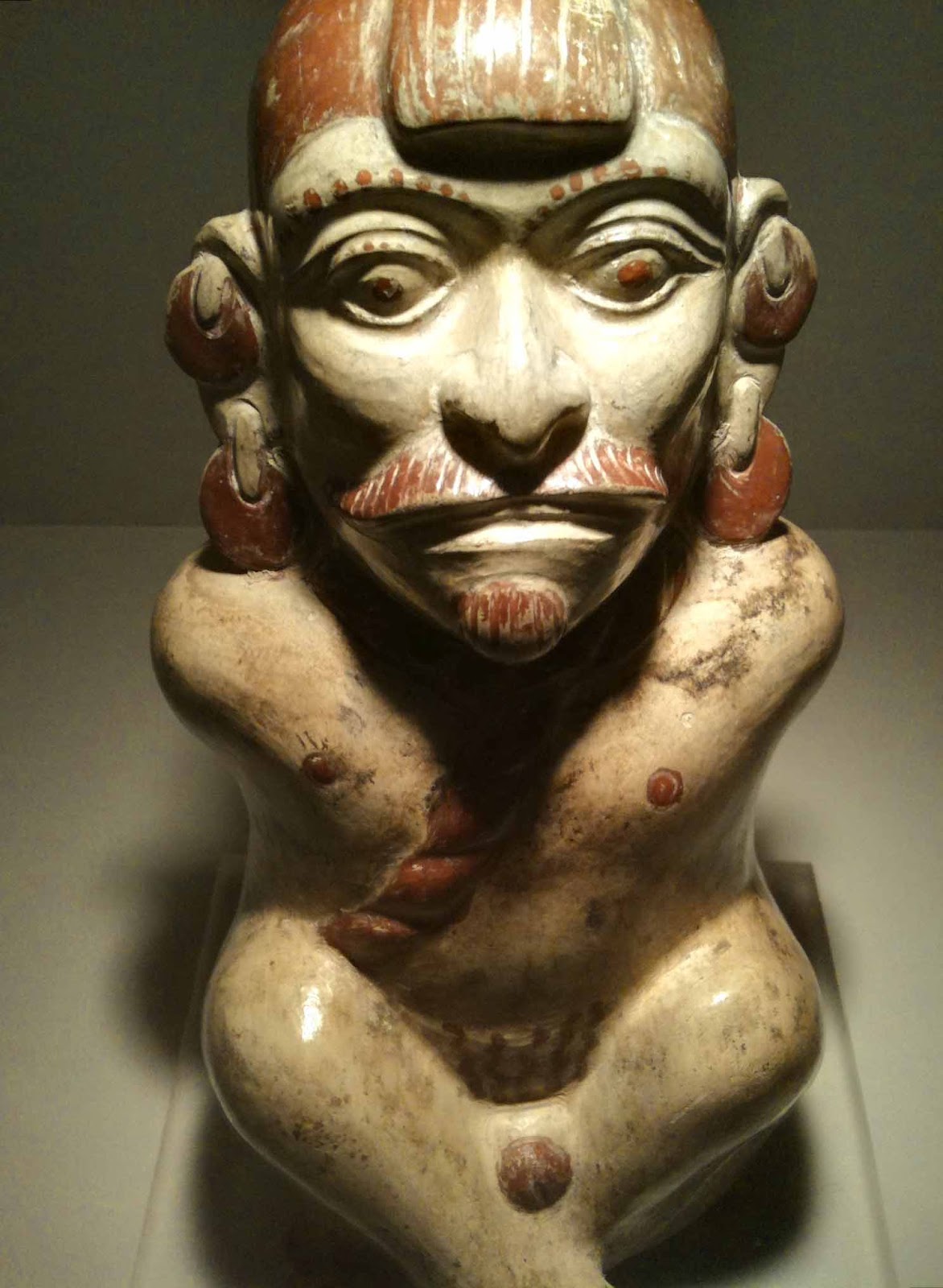
A Mochica prisoner of war bound with a rope and hands
tied behind his back awaiting sacrifice. Note the facial
hair, something not common in other representations in
ceramics, glyphs, or paintings. A stiff belt of punch from
the Peruvian Star cactus likely made the victim more
compliant and manageable prior to torture and execution.
Cannibalism was also practiced among the Moche according
to scientists. 
We visited several other sites in Lambayeque and their story deserves consideration in another post. There is no question about the upheaval, in terms of the political, social, and religious consequences climate change, brought to the societies of ancient Peru. Al Gore would confirm the link between climate change and societal upheaval. Except in this instance, the change was not anthropogenic.

Monday, January 23, 2012

Machu Picchu for Dummies

Once again the semiannual maintenance closing for the Lima Temple will be happening next week. We are excited that more of our family are coming to visit us. We will spend a week touring in Cusco, Machu Picchu, and this time a new twist, a bus trip to Puno and Lake Titicaca.  Since our last visit in August, seems like only last month, I have read a few more journal articles, and a couple books in collecting additional insights about Machu Picchu.

Tonight we are giving a PowerPoint presentation to the Family Home Evening group. RA has been researching authentic Peruvian/Incan recipes for desert.  She has prepared a quinoa pudding, topped with mango and a touch of lime zest. It was so good that I told her to look no further for any other recipes. Quinoa remains the food I enjoy and eat the most in Peru.  I am happy to know it is available at Costco when we return.
The quinoa mango pudding RA made again this afternoon.
Machu Picchu, according to National Geographic Explorer in Residence and scientist, Johan Reinhard, is “One of the very few places in all of the world where reality can surpass one’s imagination.” Dr. Reinhard's theory for the 'why' of Machu Picchu is the most satisfying of the several I have read. Other questions come to mind about this one of seven current wonders of the world such as, why was it never completed, and why was it built in such an isolated location? 
Our Peruvian friend Miky looking over MP on our first trip there one year ago.
The theories for the "why" of Machu Picchu range from it being an exclusive prison for royal Incan family members to be isolated from the current emperor to prevent any palace coups, to it being a summer residence for the founder and builder, the Emperor Pachacuti. Along the way other theories have been tossed on the table such as it being primarily a religious and ceremonial center. Lastly, it has been proposed as being a regional capital of the empire. During the rapid expansion of the Inca they  were known for establishing outposts of governance. From these centers, soldiers would be barracksed, taxes would be collected, the pantheon of gods worshipped, food and supplies would be stored, and regional commerce controlled.
The Temple of the Sun in Machu Picchu. It might have once held a solid
gold life size statue of the Emeperor Pachacuti.  The windows align for
solar and astronomical alignments and observations such as the heliacal 
rise of the constellation Pleiades or Collca as it is known and still observed
by the Quechua. 
This past July 24th marked the 100th anniversary of the "discovery" of Machu Picchu by a Yale history lecturer Hiram Bingham. George Lucas would neither confirm or deny that his character Indiana Jones was based on that of Hiram Bingham. Machu Picchu was never really "lost" and in need of discovery, though the conquistadores likely never visited it, or it might have been destroyed because of its deeply pagan and troublesome representations. The site was looted in the 1860's by a team of German treasure hunters with Peruvian government permission.  By the time Bingham arrived with his Quechua guides there was little left to loot. What he did find was sent back to Yale for study and "safe keeping." Some but not all of the Yale artifacts have been returned to Peru and a new museum in Cusco is housing them.
Their style of hats were similar though Hiram could not afford the leather jacket
Hiram had his own theories about Machu Picchu, but not being a trained archaeologist, he was wrong on almost every count.  His adventures in the high Andes did bring the site to the attention of the world.  It also propelled him to the governor's mansion and eventually to a US Senate seat. Peru's history has been one of continual foreign exploitation and Bingham was just another in a 500 year succession of foreigners capitalizing on the richness of Peru. He has been characterized as just an upper class grave robber or huaquero, as we know them down here.

The best theory for me and others as to the "why" of Machu Picchu is embodied in the work and research of Johan Reinhard. His book "Machu Picchu -- Exploring and Ancient Sacred Center" seems to offer the best explanation for Machu Picchu and does not detract much from the other predominant theory that it was constructed as an estate for the Emperor Pachacuti. 

Available on Amazon. If you buy a used copy be
certain it is the 4th Revised Edition. 
Dr. Reinhard has proposed Machu Picchu should be understood in the context of the natural geographic features that surround the site.  Its breathtakingly beautiful location must have struck the Inca in the same manner that draws a million tourists to the site annually. Venerating and reverencing mountains, rocks, caves, and rivers as sacred sites, (known as huacas), and even as gods, the location between the two mountain peaks of Machu and Huayna Picchu must have impressed Pachacuti, his priests, royal architects and engineers. Reinhard's explanation for MP is called the "Sacred Landscape" theory. The site's spectacular setting, design and construction are directly related to the significant mountains that surround it. In each of the cardinal directions is a significant mountain peak. Temple and site alignments within Machu Picchu are oriented to many and yet to be determined astronomical phenomenon including solar alignments of the solstices and equinox. The heliacal rising of the constellation Pleiades or Collca, as it was known among the Inca. was preeminent in the annual cycles of planting, weather prediction, and the harvesting of crops. The Inca worshipped and reverenced it as the guardian of seeds and planting. Americans and Japanese of course are very familiar with this constellation as it the logo for Subaru automobiles. (Thanks again Watson for your stellar education on the subject of Pleiades).
Due south from Machu Picchu is the mountain Salcantay which is important to Inca myth and lore. It was also venerated from the Inca capital of Cusco.  At the Summer Solstice of December 22 the Southern Cross is directly above and at its highest above the peak of Salcantay as observed from the Intihuatana Stone, the highest point in Machu Picchu. All of the sites we have visited in Peru from the earliest at the Caral/Supe complex to Machu Picchu have important astronomical and solar alignments. Books have and will continue to be written on the subject or archaeoastronomy and the peoples of Pre-Colombian Peru.  This next trip to MP we will have our GPS attachment for the Ipad and will be taking a few additional photos of alignments. 
We have yet to observe the Southern Cross in the 14th months we have 
here, maybe when we return to Cusco in two weeks. 
Throughout the site and elsewhere in the lands of the Inca and their predecessors is found the symbol known as the Chacana or Inca Cross. From the June 22 Winter Solstice the rising sun illuminates the Temple of Three Windows and casts a shadow of the Chacana on the floor.  I have seen this jewelry for sale and had not been interested, thinking it to possess provenance only from the Colonial or Spanish Period. Understanding the steps of the cross represent the three existences of the Inca, heaven, the current world in which we live, and the underworld of death I am now more interested in acquiring something to add to the wardrobe. The hole in the center represents Cusco, their capital of the empire. A young Peruvian friend also asked me, while walking by the Lima Temple recently, what the three steps signified in the steeple supporting the Angel Moroni? I had no answer for him. Who knows if it was coincidental or deliberate? The steps of three are significant in the iconography of Peru certainly. 
The three tiered step is found throughout Peru though maybe the spiral will 
now be replacing it. 
Because Machu Picchu was abandoned before the Spanish entered Cusco it escaped desecration and destruction, fortunately for the world. The question has to be asked, why was it never completed? Stones are left part way on their path toward installation. Important buildings were left uncompleted as were significant sites in nearby Ollantaytambo as well. The reasons for the abandonment of Machu Picchu also explain why it was possible that 168 conquistadores could defeat an empire of 12 to 25 million people and an army of up to a quarter million men.
Stones left in the quarry showing evidence of recent work and others left
sitting awaiting installation in the Temple of Three Windows. 
Two years before the Pizarro's army of thugs entered the land of the Inca, smallpox arrived there first. The Inca Emperor Huayna Capac, his son and successor, his generals and ministers were fatally infected while on a military campaign in Colombia. The internecine struggles that ensued as rival factions and other sons fought for the ascension to the royal throne created the 'perfect storm' of opportunity and circumstance for Pizarro and his men.  Two sons were named by the pox ridden emperor with the names of Huascar and Atahualpa to divide the empire and succeed him.  The Spanish were shrewd enough to use one against the other thus largely neutralizing the numerical superiority of the empire's forces and capitalizing on the discontent and resentment of subjugated peoples within the empire.
Yes, guns, armor, and horses, carried the day at the Battle of Cajamarca 
between Pizarro's 168 soldiers and six thousand Inca warriors but 
ultimately it was germs that brought about the collapse of the
largest empire in the Americas. 
Within two years of the arrival of smallpox, in what epidemiologists refer to as "virgin soil," roughly one half the population was sick or dead. Within 130 years of the arrival of Columbus estimates run as high as 95% of the indigenous population of the Americas was gone due to the European diseases of smallpox, typhus, measles, diphtheria and influenza. No natural immunity to any of these diseases existed among the peoples of the Americas. The best treatment on this topic and summary of the research is from Charles Mann's: "1491, New Revelations of the Americas before Columbus." The only gift in return to the Europeans was a particularly virulent form of syphilis which returned to Spain along with the stolen gold and treasures of the Inca.

A long period of incubation for smallpox exists allowing for its rapid spread.  At least 12 days from first contact with the virus until the signs or symptoms of the pox appear. During this period the infected host is highly contagious so the disease could spread, as they say, 'like a wildfire.' Some social scientists have pondered and weighed the near extinction of all the indigenous of the Americas as a high price to have paid for Christianity and the alphabet.
Cows, horses, pigs,  and camels did not exist in the Americas
at the time of the coming of the Europeans. Smallpox and
other diseases morphed, jumping from animals to humans. In 
Europe natural immunities developed among the survivors
of smallpox. 
Smallpox strains only exist currently in the germ stockpiles of the US Army and the Russian Republic. In the future it could be a very lethal biological weapon as generations of earth's children are not being immunized since smallpox was declared eradicated in 1980. Certainly one of the great achievements of science in the modern era. Reading about how this hellish disease brings about the sweet mercy of death, I have to agree it is one of the great achievements of medical science.
Existing stocks of smallpox held in the US and Russia should be disposed
of, lest new strains be developed and pose a threat to humanity. Potentially 
as devastating as any nuclear arsenal. 
Machu Picchu, Ollantaytambo, and other sites were never completed simply because of the European diseases which so quickly killed the inhabitants in advance of the conquistadores. Solutions were not to be found in star gazing and celestial alignments for Inca. Sacrifices to the gods availed nothing.  In areas of the Americas where disease had not preceded the arrival of the conquistadores and other Europeans the indigenous peoples were never conquered. The Zapatista rebellion of Southern Mexico has it roots in the rebellion of the Maya some 500 years ago. Florida was invaded five times by the Spanish but the locals were never defeated by them. In Brazil the Portuguese brought colonists to 14 sites along the Pacific coast. In less than 10 years only two survived.  Pedro Pizarro, a young cousin of Francisco, concluded in his memoirs without the Inca civil war between Huascar and Atahualpa the Spanish would never have been capable of defeating the Inca. Further he said, had the Emperor Huayna Capac been alive and at the head of his army in Colombia the Spanish would have been easily defeated, their horses captured for breeding purposes, and the surviving conquistadores would have been gelded to guard the emperor's wives. That was Atahualpa's plan.

One has to wonder what might have happened and turned in history if the Spanish had not brought disease to the Caribbean. I have also pondered several questions about the conquerors and vanquished. Specifically who was the worst? Were the Spanish any less bloodthirsty or driven less by conquest than the Inca? I am not sure I have an answer, but I do have an opinion. It would be this

In the totality of comparison between the Inca vs. Conquistadores, in terms of brutality, and inhumanity to man, the Inca exceeded the Spanish with very little argument. Pertaining to the larger view of culture and civilization, the Spanish were guilty of cultural genocide and annihilation of the greatest magnitude and scale. Nothing in my study or knowledge of history compares to this so total and complete annihilation. Compounding the systematic and deliberate destruction of the icons of culture and religion of the indigenous peoples of the Americas, such as the temples, ceremonial centers, huacas, and shrines were the unforeseen consequences of biological warfare brought to the Americas by Christopher Columbus and subsequent so called European “explorers.” 


Machu Picchu -- The most beautiful place I have ever visited
Each time we have visited Machu Picchu we discover and learn something new. We continue to be impressed with its beauty. The Inca were far from the characterization of Spanish chronicler and priest, Father Bernabe Cobo, as being "simple minded and ignorant barbarians" under the spell of the devil. On the contrary, their achievements left in stone at Machu Picchu and elsewhere, rival anything this world has ever seen or has been created by man.

Saturday, December 31, 2011

Milestones, the Lima Peru Temple, and Joseph Smith

We mark the end and passing of 2011 in Lima Peru as temple missionaries.  We are more than a week now passed Christmas, the Summer Solstice in the Southern Hemisphere, and about to enter 2012. The year has gone by quickly as we count down the remaining months until we will leave the work each day, the good friends, this beautiful and incredible land, and return home to Utah. The hardest part for both of us is missing friends, family, and especially the grandkids.  Video chats via FaceTime and Skype bring them closer as compared to prior generations of missionaries using only a telephone or written letters. We are grateful for that.
Christmas 2011 at the Lima Temple
This morning we are off to visit our friend Cesar going to a special market area in old Lima known as La Parada. Cesar has taken us there before and we have found it fascinating. No watches, wallets or cameras in sight are recommended and we don't go there in the evening either. It is at the opposite end of the spectrum from upscale Jockey Plaza filled with its stores and glitz that make it indistinguishable from any other mall in America or Europe.  Our goal today is to find a number of fruits and vegetables that are grown in Peru and sold at this market, including a few different kinds of potatoes or papas that we have not enjoyed before. Also on the list are foods that originated in this hemisphere but have spread elsewhere throughout the world and remarkably did so Pre-Colombian or European.  That is to say, quite an astonishing number of Andean and South American food stuffs and other items traversed both the Atlantic and Pacific Oceans prior to the arrival of Spanish, Portuguese conquerers, and English explorers. Multiple tests with gas chromatographic spectroscopic analysis done in European labs have found Peruvian coca or cocaine as well as new world tobacco in the tissues and bones of 3,000 year old Egyptian mummies. The list of goods and items both originating in Peru and arriving here from Asia is significant and merits a post for another day. We'll see how many items we can find in La Parada of things that traversed the ancient world prior to the coming of the Europeans.

This blog site has reached a milestone in recent days in closing out the year having passed more than 10,000 visits since it was launched some 14 months ago. The topics have been, for the most part, narrowly focused on our travels, our life in Peru, and of course the food we enjoy. All of this being outside of the experiences of working in the Lima Temple. Properly so, the things that transpire that RuthAnn and I have shared in that special place remain there and are not to be published here. They remain private to us and are special. They are hidden away in the places of the heart and our souls.

The most widely searched and visited post on the blog is about food. It is clearly the single most searched after topic of anything we have written about or experienced. It is about cebiche, that unique uncooked but processed with a marinade fish I have come to enjoy so very much. Cebiche is also on our weekend schedule to share with our friends the Ramos on Monday. They too are nearing a milestone in their two years as missionaries in the Lima Temple.  When the temple closes again for maintenance in February they will return to their home in Arequipa. We will miss these very good and wonderful friends.

Absent from this blog in 14 months has been any statement or expression on my part about my feelings and thoughts concerning faith and the religious experience that ultimately is the basis and reason we are here and not home enjoying our family and grandchildren among other pursuits. It is therefore appropriate and overdue that I should write several lines to close out this blog for 2011.  Joseph Smith, as much as any man in American history, has been investigated, written about, praised by those who admire him, and maligned by those who oppose him for what he did and has come to represent. I believe he deserves a few lines here based on my personal respect and admiration. No, he was not perfect.  In so many ways he has been found wanting in the court of critical opinion in political or social correctness. But he was perfect, and I am eternally appreciative for him, in his giving it his all -- all that he had and cherished, for his sacrifice to the cause of faith and laying the foundation of this great Latter Day Saint work. I make no apology for him, as he needs none, and I make no apology for my love and belief in him and all that he did and accomplished.  Few people I have associated with, on a non professional historian level at least, over the decades have read more or studied about our history in critical ways than I. Family traditions and stories have been handed down creating a personal link to him through a grandmother in Nauvoo. Some have left the Church over related issues such as ours and lesser matters. My personal court of opinion has weighed all of the information, good and ill. Everything that I have read from and about our history, both within and without, at year's end I raise my voice in respect, love, and 'Praise for the Man.'

With love and affection too, for family and friends with whom we share these things -- We thank you for all that you mean to us, your support, and with anticipation look forward to renewing friendship and association once again.

And here's to you Brother Joseph: http://youtu.be/k5id63Twddk -- a link to the Mormon Tabernacle Choir and Orchestra at Temple Square performing their "Praise to the Man."

Sunday, December 18, 2011

The Earliest Image of God in the Americas?

We recently returned to Caral, the earliest urban center and civilization in the Americas, one of six cradles of civilizations in the world.  We went armed with more information having had benefit of reading and studying about the site and the Norte Chico people who built it. The site is surrounded with controversy pitting archaeologists in Peru and America against each other. The acrimony, finger pointing, and public accusations are only equaled by the current deficit reduction talks between congress and the Obama administration. Claims of plagiarism, sloppy science, and personal aggrandizement have been tossed back and forth between scholars, casting a shadow on future joint projects. A Peruvian scholar by the name of Ruth Shady Solis is responsible for gathering all that we know and have about this important and earliest civilization in the Americas.  Carbon 14 testing and the money to do so came from the USA.
Turistas en Caral. The covered area behind us is a circular chamber 
surrounded by a square retaining wall. Squares encompassing circles are 
common motifs in Caral and elsewhere in the ruins and sites of pre-
Colombian Peru. 
Though Caral was first visited by scientists early in the 20th century it has been largely ignored even by the grave robbers or huaceros as they are known, since no precious metals were to be found. The Norte Chico civilization built it some 5,000 years ago. Additional work, and carbon 14 dating is underway which may push the beginnings of Caral even further back. The people of Caral and other sites on the North coast of Peru were pre-ceramic, meaning they did not fire their pots, only sun dried clay. Without the lure of gold and other treasure to loot, it was left to sleep under the millennia of wind blown sand and El Niño rains and flooding. The site is not often visited by foreign tourists and no English speaking guides are provided. We have watched bus loads of Peruvian school children unload at the visitor's center. Caral lacks the appeal and beauty of Machu Picchu and other more well known ruins in Peru for foreign tourists, yet it is a fascinating and remarkable site nevertheless. We plan on returning again to the coastal site of Aspero as we ran out of time on our last two visits. There is a debate whether this nearby sea coast settlement of Aspero rose before Caral or came after. Traditional theory states that for a city to rise, the surrounding lands must be developed for agricultural production to support the division of labor with sufficient daily calorie intake to move or advance from bands of hunter gatherers to city building. Proponents of Aspero first, say it rose ahead of Caral due to the abundance of available marine protein for the diet such as shellfish and sardines. Each theory has its detractors and defenders. At best, all of this is to say that the science of archaeology is evolutionary and subject to change with notice. Theories are continually modified to accommodate the most recent discoveries.  
Our group in front of the Pyramide Mayor in Caral
In order of priority I was impressed with Caral, not because it was as masterfully constructed or as beautiful as Machu Picchu, but because of its unique role and prominence in history. I was struck that there were no defensive structures, barriers, battlements, or walls in Caral. "Imagine all the people" in living for today, (actually for a thousand years), with "no countries, nothing to kill or die for... Scientists have found no weapons, no disfigured skeletons with broken skulls, no victims of war. Shields. body armor, and clubs, the weapons of a warrior class of any kind have been found in the excavations.  It was a peaceful society. Flutes made from pelican bones as well as sunbaked clay versions have been recovered.  In one temple cache 38 instruments believed to be bugles was excavated. This confirms music was a part of their society and religious worship. Have to wonder what their music might have been like. Without a warrior class scientists suggest the motivating factor for the monumental construction of Caral was religion. The religious priest class was supported by literally thousands in the construction of their pyramids and urban centers. In return the masses were assured the beneficence of the Gods bringing water in the Supe River for crop irrigation for adequate crops and harvests.
These flutes were recovered from Caral along with pan flutes and rattles
The earliest image of god recovered in the Americas was found in Caral. It was, or he was, carved into a gourd, and has been dubbed the "staff god" because he carries a staff in the right hand. His left arm terminates in the head of a snake. The experts suggest this early image of a god would be copied and used by successive cultures such as the Chavin and even to the Inca and their god Viracocha. This religious pattern began and emanating from Caral is called the Kotosh Religious Tradition. The serpent, among other icons including the puma/jaguar and condor, played a very important role in many early cultures in South America and throughout the world. These symbols would continue for thousands of years until the Inca were conquered by the Spanish. Moses raised a brass serpent on a staff for the Israelites to look upon to heal them from their encounter with poisonous snakes as found in Numbers 21:8-9. Peru and South America have a number of venomous snakes but most of them are found in the Amazon regions to the north and east.  Coral snakes and vipers are the most common of the poisonous variety though in Caral the bite of any snake would have spread infection and likely resulted in death for its inhabitants. 
Photo Courtesy of Jonathon Haas and The Field Museum. Insert color 
adjusted for clarity. 
The first example of a written language in the Americas was also recovered in Caral, though it is still being debated and explored. Known as Khipu, these strange knotted and twisted cords of cotton string and other fibers were used at least to store data and were perhaps a system of writing. Professor Shady and her group found a cache of items in one of the pyramids of Caral including the khipu. A team at Harvard University has been using sophisticated computer software to try and decode khipu from the Inca but so far it has largely evaded their understanding. No Rosetta Stone has been found to assist in decoding it.  It may have been just a binary system for recording the numbers of alpacas and llamas in the king's or ruler's stable or how much tax was collected during the previous season.  Debate continues as to whether it was actually a written language. It is hard to imagine the Inca, who had an empire controlling some 12 million people, managed to do so without a written language, only khipu.
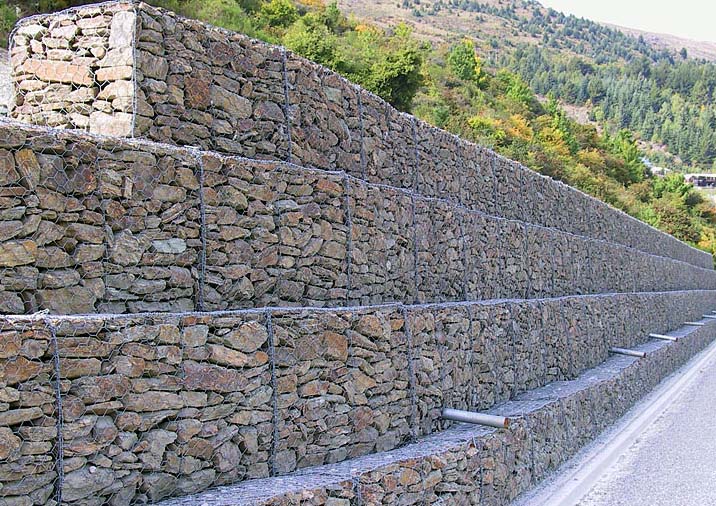
The builders of the pyramids of Caral seemed to understand seismic design in building their structures. They used packaged rocks in bags called shicras made from reeds and or cotton to fill in between the walls of their pyramids. The incarceration of rocks within a restraining mesh or netting is called a gabion. Today instead of marsh reeds civil engineers use gabions to restrain earth movement and erosion along river banks, the seashore, and freeway overpasses.

Present day use of gabions
Shicra bags were filled with rocks, dragged to the building site, and placed
between walls for seismic stability. 
While we were strolling around Caral I asked our guide Miriam if the duality we have seen represented in other early archaeological sites was present in the temples or huacas of Caral. She responded affirmatively that they are found everywhere.  This just seems to be part of the cosmology and religion of   many ancient peoples. The opposites, the dialectic, or duality of things akin to the yin yang of Asian philosophy was a part of pre-Colombian Peru. For awhile we actually had yin yang symbols as part of the decorative features of the Bountiful Temple until one president had them painted over during a semiannual maintenance closing. They are now lunar phases more in keeping with symbols found on the Salt Lake Temple.
The Pyramide Mayor with symbolic stones representing duality.
Our guide pointed to these stones on the first landing of the great pyramid of Caral. These are the light and dark stones on either side fronting the stairs.

My compass indicated the Huanca and the pyramid in the background would
correspond to sunset of the Summer Solstice of December 22 in the Southern
Hemisphere. 


Caral was laid out to the cardinal directions of the compass. Solstices, both winter and summer, are observed from the two meter tall Huanca Stone. This stone aligns with the tops of the two adjacent pyramids.  Other sites probably signaled astronomical events associated with life; planting, harvesting, and the cycle of life.  The ever present spiral carved into stone in Caral and found throughout neolithic Europe and Celtic sites was part of Caral's mythic lore. Discussion continues and likely will not ever be resolved what it meant to early peoples throughout so much of the world.
The spiral is found carved into stone in one of the steps
leading up a staircase of a pyramid. 
Another stone was pointed out to us by our guide and maybe it is a star chart or map.  It does not represent the location of the home world from which ancient astronauts came to carve the images of Nazca.  Most likely it was a reference for astronomical observances relating to the seasons of planting and harvesting. I am waiting for my friend and knowledgeable astronomer Watson to shed light or confirm the stone is something more than a non skid surface. I am voting it illustrates the Pleiades, known as the Seven Sisters, also the emblem of Subaru automobiles.
About one half of the stone that our guide suggested was a star chart. 

The Constellation Pleiades, M45, or the Seven Sisters
Eventually, as has been suggested by scholars, this earliest city of Caral would be abandoned for the more rich agricultural regions to the north. Altogether, the reasons for the rise of Caral in this relatively dry and desert like environment seem incongruous, supporting the validity of the claim for the maritime foundations of the first civilization at Aspero. For the present at least it lays claim to being the first city of the Americas and it is found here in Peru.