Favorite recent and insightful quote I have read recently:

Favorite quote I have recently read: "The word temple comes from the Latin templum, which signifies an extended open space that has been marked out for the observation of the sky. In what manner is such a space marked out? According to Dr. Hugh Nibley, the word templum, "designates a building specifically designed for interpreting signs in the heavens--a sort of observatory where one gets one's bearings on the universe." The root "tem-" in Greek and Latin denotes a "cutting" or intersection of two lines at right angles, the point where the "cardo" and "decumanus" cross, hence where the four regions come together." Matthew Brown - "The Gate of Heaven"

Thursday, April 28, 2011

The Oldest Solar Observatory in the Americas...

We are trying to work out a weekend adventure to get to Chanquillo, also spelled Chankillo. It is north of us on the Peruvian coastal desert plain and is on the way to Chimbote. A few years ago a Yale University archaeologist  from Peru began seriously investigating the site, not for its astronomical significance, but for a very well constructed fortress. For decades, even centuries, no one understood what the 13 stone towers across the top of a prominent hill meant or were used for by the ancients. The scientist who solved the puzzle of the 13 towers is Ivan Ghezzi. Many of his papers are available in PDF format on web.
The 13 stone towers of  Chanquillo
Photos courtesy of Ivan Ghezzi
Since we had visited Caral our interest in archaeoastronomy in Peru has been piqued to some degree. Archaeoastronomy has been defined as the study of beliefs and practices relating to the sky in the past, especially in prehistory, and the uses to which ancient people's knowledge of the skies was utilized.
Sunrise of the Winter Solstice in June 
Chanquillo dates to the 4th Century BC. Archaeologist, Ivan Ghezzi, noted that "research in Peru is constantly pushing back the origins of civilization in the Americas. In this case the complete solar observatory at Chanquillo is the earliest such structure identified." It predates the Mayan observatories by 500 years and the Inca by 1700 years. The peoples who constructed both the solar observatory and the nearby fortress have not been identified as of yet. They predate the Moche/Chimu and followed the Norte Chico. Unlike Caral stone weapons have been recovered from the site. The 13 stone towers gave the locals accurate dates throughout the year within a two or three day accuracy and told them the dates for the summer, winter solstices and the equinox.  That was sufficient for them to plant their crops and to know when other important ceremonial observances should take place.
The hill of the 13 stone towers with the added artist's demarcation. A similar
observatory is opposite the hill for the sunset.
A film crew from the BBC with narrator Brian Cox has visited the site and filmed the rising sun at Chanquillo. The video can be viewed with Professor Cox's narrative at this BBC site for science and the environment. 
The fortress
Chanquillo, in addition to the fortress, includes a large ceremonial center. Altogether it  covers almost a square mile. Its 13 stone towers stretching a thousand feet across the hilltop draws visitors to the site.  Maybe we can watch and video a sunset. Dr. Ghezzi concluded the fortress was likely used for ceremonial purposes, rather than for valley defenses for a number of reasons.
The 13 solar towers as seen from the fortress
Today we confirmed the names of three different tour operators and guides that might be willing to take us there. Our next post about Chanquillo will have our own photos and images from the site.

Sunday, April 17, 2011

Caral -- The Oldest City in the Americas

Because of the Peruvian Federal elections the temple was closed on Saturday so we traveled north of Lima for a little more than three hours along the Pan American Highway to our destination of Caral.  We hired Pedro, one of our two favorite taxi drivers for the day. His wife Carmen Rose came along also.  We took almost twelve hours of their day. They speak no English, so it was a nice opportunity to visit as best we could and exhaust our limited vocabularies. RA prepared a great picnic lunch we enjoyed with them.

GF, Pedro, Carmen and RA in front of the Great Pyramid 
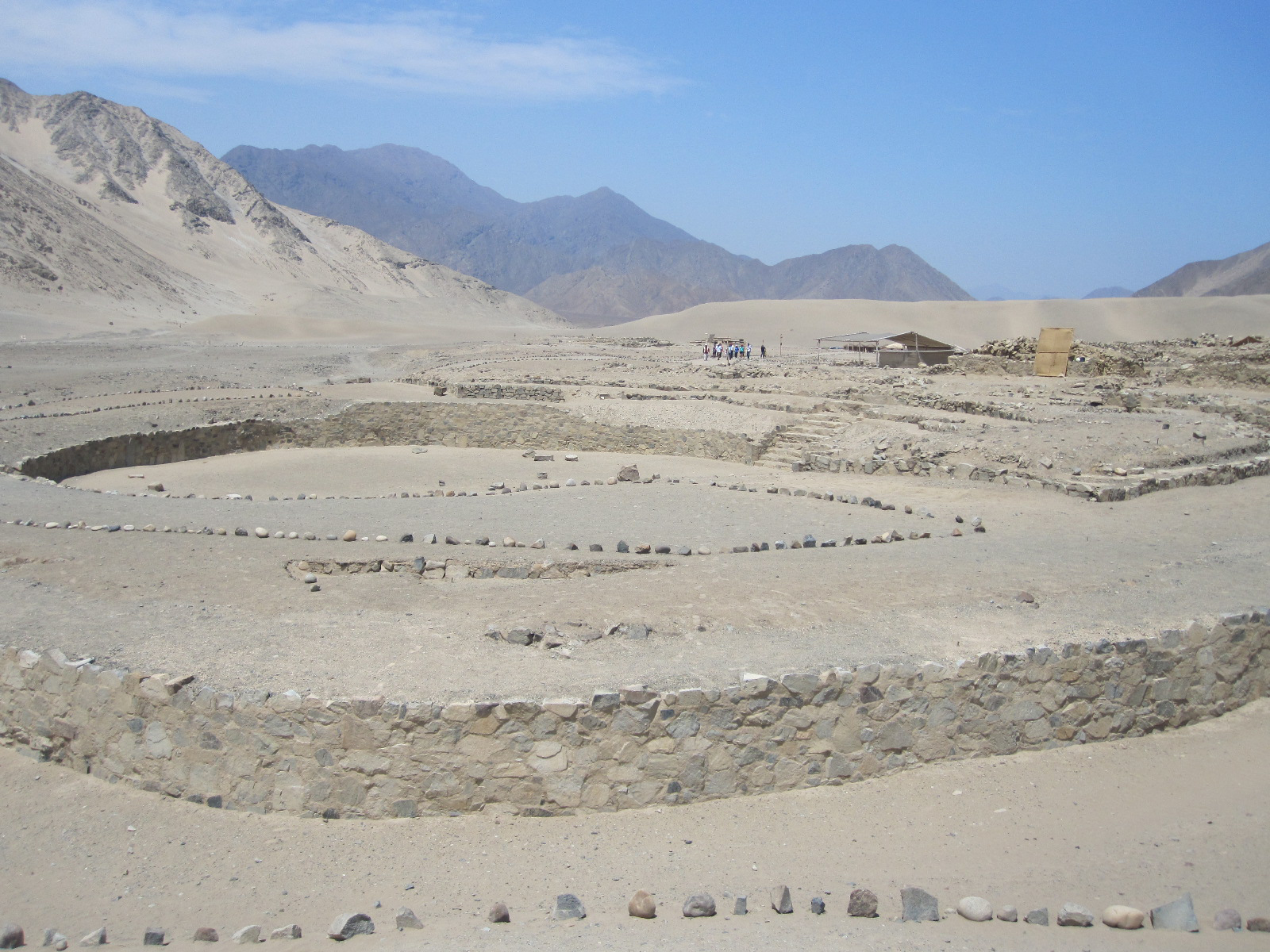
There are a number of ruins collectively known as the Caral Supe. It flourished in this Supe River Valley between 5,000 and 4,000 BCE, making it the oldest city in the Americas, thus making it contemporary with the Egyptian Pyramids and the city of Sumer in Mesopotamia. Archaeologists suggest it is one of 30 major population centers of the north central coastal area of Peru of the Norte Chico culture. This civilization was pre-ceramic, meaning no fired pots only carved stone plates along with sunbaked pots and kitchen ware. The society was advanced in many ways  including extensive canal building and irrigation from the Supe River. The area along the river is still farmed today but otherwise it is a very dry and arid place.
Peppers, corn, potatoes and a number of other crops are still farmed today
Estimates are that Caral existed for a thousand years and at its high had a population of 3,000.  Climate change today is eroding a very large dune behind one of the major pyramids exposing ancient burial sites.

The dune in the background is being eroded after 5,000 years

Archaeologists believe the Caral was organized as a huge calendar. Every public building, pyramid, and temple was constructed as homage to a particular deity and each "respects a specific astral position."
The Large Amphitheater
We were shown this carved granite stone with a number of pock marks on it as the entrance of one pyramid that I assumed were just for "non skid" purposes. Our guide book suggests it was a star chart and associated with the activities of observation from the pyramid. Next time we are there maybe I can find Pleiades on this Caral stone star chart. It was an important constellation for ancient peoples in recognizing both the vernal and autumnal equinox. 
The stone with the star chart is closest at the bottom of the photo
Feline forms are constructed into the pyramids, the origination for the much later Incan use of the jaguar. Birds and serpents are also found in the form of stone petroglyphs and carvings. The three symbols of existence for the Inca and Caral were the serpent which represents the underworld or death, while the jaguar is our present existence and the condor or bird represents the future life. We were not allowed into the pyramidal structures to photograph these feline forms and more. Petroglyphs are common in Caral. The ubiquitous and mysterious spiral is found here as many other ancient cultures including the Anasazi of the Southwest US. It seems it was important to the Celtic peoples as well. 

Spiral carved into granite near one of the pyramids.
Oddly, very few weapons have recovered from these sites suggesting to those who know that it was a very peaceful society.  They thrived for approximately a thousand years, but then began moving north to more fertile areas but still extensively used irrigation from rivers to grow their crops. A number of musical instruments have been recovered suggesting music was a very important part of the Caral society. These consisted of flutes and recorders, made from bone, clay, and stone.
Sculture of a male surviving these many millennia
Of significant interest to us were the evidences of archaeoastronomy in Caral. A stone monolith of some 2 meter in height called "La Huanca" was uncovered and connects it with the adjacent Galeria and Huanca Pyramids. It happens the angle of the stone to the tops of the pyramids marks the location of the summer and winter solstices of about 40+ degrees. I have looked for additional information about this angle but have found little so far.

The Huanca stone aligns with the tops of these two pyramids
Also of interest are the temple symbols we found both in Caral and in Machu Picchu. The quadrature of the circle remains a part of many civilizations it seems. Several squares with circles exist in Caral as they are found in our Temple in Bountiful, here in the Lima Temple, and many others. Brother Nibley and others have written about the meaning of the square and the circle in temple worship.
A circular enclosed area inside a square with the accompanying notation that
 it was designed to admit one person at at time
Note the square and the circle of this temple pyramid. This photo was borrowed from a
a book on Caral we purchased in Lima. 
In the residence portion of Caral we noticed this "Inca" looking door construction and found it interesting.  According to our guides at Machu Picchu this shaped door has greater strength in resisting earthquakes so common in the western portion of South America.
Note the doorway or window in the almost tumbled down wall
We want to go back again to Caral as we missed a number of sites within the city ruins including more petroglyphs and temples. 14 miles from Caral on the coast at the mouth of the Supe River is another set of ruins we did not take time to visit.  We have been told by friends the beach and coast, with tide pools and sea life is not unlike La Jolla CA.
*A petroglyph of quipu, a type of ancient writing system continuing
to the Inca where it was lost with the arrival of the conquistadores
Peru remains a fascinating place with an incredible history and great natural resources. The people are industrious and talented. They work very hard to live and exist, especially those outside of immediate prosperous neighborhoods of Lima where we are. The people sent a strong message to the government this past week on election day. The left leaning socialist candidate received a majority of the vote.  A runoff will happen in the next month to determine the direction the country will go.  It seems the theory of trickle down economics  practiced by Peru's recent leadership has benefited a few, but not enough for all the people.

*A post on quipu or the Inca and Caral writing system will happen on another date.


Monday, March 28, 2011

Chile Debe Devolver El Huáscar...

This past week we were treated to a walking tour of old Lima by our friends the Andersons.  They are extremely knowledgeable about Lima, its past and present.  We visited several colonial era homes, or maybe mansions would be a better term including that of Admiral Grau, as well as a beautiful 18th Century Cathedral. We took a few photos to share. Inside the Cathedral of the Virgin de Mercedes, simply known as the Merced Church, there were warnings about not using your cell phone but no proscriptions against photography. The Virgin Mercedes is the Saint responsible for the guns of Peru.  Peru's history has not been an easy one, but rather a violent one.  More than 170 civilizations and cultures have been identified here before the Incan armies swept over the Andes Mountains, highlands and coastal planes prior to the Spanish conquest. We had lunch by a  very pleasant water fountain where only recently Francisco Pizarro's heroic statue had stood. It was removed by Lima's last mayor to another site, less in the public view, by design.  Warfare and conquest are all the people here have known through their entire history up to the start of the 20th Century. A border dispute with Ecuador led to several smaller battles in 1941 and again in 1995. It was only settled by diplomatic efforts of the United States, Chile, Argentina, and Brasil in 1998.
RuthAnn and the Andersons, our guides
It is quite natural then for a church to be located on the Plaza of Arms with a Saint to look after their guns. I have been told that in the War of the Pacific invading Chilenos soldiers fathered a number of babies without benefit of a last name and the Lima white pages today list a number of surnames simply as "Chilenos." The conquest and the occupation of Peru by Chile for a decade still can raise tempers and the ire of more than a few Peruanos. I supposed this would logically spill over to the soccer field and with a little research this was confirmed.  A cup has been created called the Copa del Pacifico for the winner of the The Ecuador, Chile, and Peruvian soccer teams. CNN has noted the competition for the Pacific Cup is among the top ten rivalries in the world, surpassing even that of Utah versus BYU.
Merced Church on the Plaza del Armas
Among the booty of that war was the loss of Peru's flag ship the Huascar and the death of its valiant and honorable Admiral Grau. The Huascar was a "Monitor" Civil War type vessel and was very effective in delaying the invasion of Peru by Chile. Prior to that it was used in the region's rebellion and war of independence against Spain. It took nearly the entire Chilean Navy to stop the Huascar and capture it and its crew.  The Admiral died from injuries sustained in that last sea battle. As a prize of war it was taken to Chile and made a part of their navy until the mid 20th Century.  A number of Peruvians would like it returned to Peru where it rightfully belongs.
Interior of the Merced Church
Later in the week we had a group of missionaries from the CCM (MTC) here in Lima and I noticed one had a lapel flag of Chile on his suit jacket. In my best Spanish I suggested to him Chile needed to return the Huascar to Peru.  My request was greeted by good natured agreement and chuckles from all of his Peruvian missionary friends. They all knew exactly what I was talking about.  This was as they were leaving and picking up their checked cameras at the recommend desk which I was manning for part of the day.
An artist's conception of the Huascar during her fighting days. Note the Flag of Peru on the stern
We continue to be fascinated by Peru's rich culture, its history, and heritage. Troublesome portents are on the horizon for Peru as there is a politician rising in the presidential polls after the manner of Hugo Chavez of Venezuela. Narco money has been tracked and is found in presidential politics. As noted previously, Peru is the number one supplier of cocaine in the world. Though the economy is growing robustly, only second to China this past year, that wealth is and has not found its way to the poor, of which there are so many yet in Peru.
The Huascar today as it lies at anchor in Chilenos' hands

Wednesday, March 9, 2011

King Herod's Temple Tax

From the Gospel of John, the 2nd Chapter: 

13 And the Jews' passover was at hand, and Jesus went up to Jerusalem,
14 And found in the temple those that sold oxen and sheep and doves, and the changers of money sitting:
15 And when he had made a scourge of small cords, he drove them all out of the temple, and the sheep, and the oxen; and poured out the changers' money, and overthrew the tables;
16 And said unto them that sold doves, Take these things hence; make not my Father's house an house of merchandise.

In the days of King Herod's Temple all adult Jewish males were required to pay an annual tax of one silver coin called a shekel, or more accurately in value a half shekel. The equivalent of the coin in today's monetary value is uncertain. Silver in that time period was valued approximately the same as gold due to its scarcity before the influx of New World silver. Much of it from the Inca here in Peru that would come some 15 centuries later.
The Silver Shekel mounted to a tie bar. 
Today, 20 centuries later, I am returning this temple tax or silver shekel to a temple and will do so every day. Gone are the days when the peace of the temple was disturbed by those exchanging Roman and Greek coins for the only approved coin in its day - the Tyrian Shekel. The irony of this is the image on the coin is the chief god of the Phoenicians, known as Baal. Having coins with Caesar's image was deemed to be blasphemous or sacrilegious and rejected by the scribes and priests. The Jews did not mint their own coins until the revolt of 66 CE. Having a coin with Baal's image somehow was less offensive to the Jews. Perhaps the answer lies in the fact Roman silver coins were both inflated and diluted containing only 70% silver while those from their neighbors in Tyre were 90% pure.

Money-changing in the temple for paying the annual tax according to Brother McConkie “involved weighing the coins, taking deductions for loss of weight, arguing, debating, disputing, bargaining, oftentimes using scales of questionable accuracy. Tables piled high with coins of all denominations and nations were the stock in trade of those who charged a fixed fee, and more, in the lucrative enterprise.” In addition to the lucrative business of monetary exchange, animals, birds and other goods and commodities necessary for offering sacrifices were for sale and kept within the outer courts of the temple grounds. The chief high priest Annas arranged to have his sons hold this lucrative franchise. When Jesus upset the tables and drove the animals out he struck at the bulging pockets of the profiteers and ultimately at the chief priest. In three years hence he would appear before Annas with a far different outcome and one very pleasing to the high priest we are certain.

The significance of the the silver shekel, also according to historians, likely this denomination of coin, (actually thirty of them), was paid to Judas for betraying the Lord. The coin I carry was minted in 125 BCE and one can only imagine the numbers of hands it changed and the stories it could tell through the millennia. Now it is here in Lima Peru with me each day. As a high priest I carry it once again to the Temple. Gone are the money changers and merchandisers who profited and gained their lucre by desecrating the Lord's House. This Temple is a place of peace, solitude, and joy for the restoration of that which was destroyed and lost so many years ago.  

Monday, February 28, 2011

World Record Cuy "Jimmered" in Peru

As a follow up to our recent trip to Chimbote we were invited to participate on a hunt for a very large guinea pig, known locally as Cuymaximo. There have been stories about such giant animals but none have been seen in recent times. Wall paintings and etchings at Coral, the oldest city discovered in South America, suggest they frequented the area millennia before. This critter, part of the rodent family, was consuming large quantities of mangoes. The area of our hunt centered in orchards of a community north of Lima called Barranca. The mango fruit producers, like others engaged in agriculture in Peru, pay a very high tax of 14% to the federal government, so the devastation to their local mango crop was causing serious financial stress. The locals told us this animal would easily strip an entire tree of mangoes in just a few minutes.  Seems it has a voracious appetite and favors mangoes above alfalfa or the local grasses. Cuy are crepuscular, meaning they are most active during dusk and at dawn, not unlike deer and elk that I have hunted in the intermountain areas of Utah, Wyoming, and Colorado. That is when we focused the hours of our hunt, early in the morning.
Some of my friends who helped me with this animal
Accompanying us on our expedition were representatives from La Molina National Agrarian University.  Tissue samples and blood was taken in order to determine, if possible, why the enormous size of this particular animal. This university has been working with Cuy since the 1960's in order to breed larger sized animals. The goal of this university research would perhaps make them more economically sustainable in South America as they are much easier to raise than traditional livestock including cows and alpacas. Secondly, the upside potential for foreign export to other countries and areas in the world including the US, Western Europe, Japan, and Canada is huge.
Soon to be ripe mangoes hanging from the tree
Cuy as a food source likely began 5,000 years ago in the Andean highlands and coastal regions of present day Peru, Ecuador, Bolivia, and Chile. Held in such high regard among the native peoples here,  religious festivals now tied with particular Catholic Saints holidays, are held annually honoring these animals. 

I took the shot with a locally supplied, but in excellent condition, civil war era, .64 caliber black powder musket. It was on loan from the Museo de Armamentos of Lima. The range was estimated at 75 yards which is a fairly long one for black powder. Muskets of this era are notoriously heavy barreled and I had to use a tripod to steady the aim.  Cross winds are not a problem with the 1200 grain lead ball.  It was necessary to be no more than 90-100 yards as the expectation is the ball must have some killing power for a Cuy of such enormous proportions. The hide of the Cuy is well known for its toughness and this animal was no exception. I placed the shot in the nerve bundle just below and behind the left ear.  It was far enough back that the head mount will not be compromised. I understand it will be on display at the aforementioned university after it is studied more carefully. As for the meat, the university released the carcass to a committee of town folk including the "alcalde" or mayor of Barranca.  The heart was immediately cleaned and bagged and within hours we were enjoying some of the finest anticuchos we have ever tried.  We may well have been the first to enjoy Cuy anticuchos since antiquity. I have been told by my friends that as you get further north from Lima the food and especially the type of seasonings change and really are much better. That certainly was the case with this Cuy. The animal prior to the cleaning process tipped the scales at just under 475 KG's. 
Anticuchos and Peruvian corn known as choclo, delicious!
All in all, it was a good day hunting with friends. Their scouting work and efforts really paid off as we bagged this animal shortly before sunrise. Now the locals will not have to stand guard duty of their mango crops 24/7 any longer. The university can continue their research in optimizing and developing their genetic strains for producing larger animals. On a side note, BYU is sending a team of archaeologists to analyze this animal and to take plaster casts of its unusual hoof like feet. Speculation suggests it may have been related to the "horses" so far not found in Pre Colombian South America. Similar type prints have been discovered in Nine Mile Canyon near Price Utah, dating to about 5,000 BCE. 

Monday, February 14, 2011

Road Trip to Chimbote Peru

We took a two day road trip along the coast north of Lima. Our destination is somewhat well known among missionaries I know, at least those who have served in this backwater and marine fishery center known as Chimbote. There is a very distinct odor of sardines being processed here though we stayed in the newer southern part of the city with a lessened aroma in the air. 
The PanAmerican Highway stretching north from Lima
We traveled the Pan American Highway some 260 miles from Lima to our destination at the Buenos Aires Stake Center in southern Chimbote. The PanAmerican Highway, though impressive in scope of more than 29,000 miles from Prudhoe Bay Alaska to the tip of South America leaves much to be desired. The pavement is far from smooth or maybe the Nissan SUV we were riding in just really had terrible suspension. Portions of the highway are dangerous due to the narc and coca culture in the jungles of Peru, Ecuador, and Columbia. In Peru the road is dangerous for a number of other reasons. More than a few drivers turn off their lights at night to save their headlamps and it was reported to us that trucks or busses, which do breakdown with regularity along with cars, are left where they died, no attempt being made to remove them to the roadside. The highway is also shared with the ubiquitous moto taxis that thrive in the smaller cities along the way and in the poorer areas of Lima. More than a few slower moving trucks had tree branches fastened to the backs of them. We were told this was to prevent the bandits from jumping on board the trucks and removing the cargo as the trucks slowed, and they were very slow, going up the hills along the highway. The tree branches possess very long and numerous thorns sufficiently able to discourage highway robberies.
Thorn branches tied to a flatbed to discourage highway thefts.
Leaving Lima we looked for the signs leading us to Ancon on the PanAmerican Highway. Ancon was once an upper scale beach retreat and resort area near Lima. No longer is it a mecca for the wealthy and mobile as they seem to have abandoned it for the playas or beaches south of the city. Ancon occupies it own place in history as it was the original and oldest source of Pima cotton in the western hemisphere. Who can say whether Egyptian cotton predated the “Pima” cotton of Peru? The name Pima is not Peruvian but comes from an effort in honoring the Pima Indians of Arizona who worked with the USDA in growing cotton there. Cotton fabrics and balls have been found in the Ancon region as early as 4,000 BC. Some accounts place cotton farming as early as 6,000 BC. So fine is this Ancon/Pima cotton it was woven with silk throughout history. I would like to find an XXL Pima/Ancon cotton shirt here in Lima before we leave.
Houses along the way fashioned from woven bamboo panels, sides and top.
Chimbote was our destination as our neighbors and friends upstairs, (first counselor in the temple presidency,) were invited to speak in the Buenos Aires Stake of Chimbote. Forty some years ago the first branch was organized. Claim is made by Elder Gregory Larson of Centerville and his companion for this honor. To date there are now three stakes and fifteen wards there. The growth of the church follows that of the region. It has been very robust. Earthquakes, floods, and declining anchovy, sardine, and mackerel populations have caused economic challenges and turmoil through the last decades from the highs of the 1970's. Catholic diocese in the US raised significant sums of money for out of work fisherman and factory workers in Chimbote during the lowest of those cycles. In other regions Peru continues to export its natural resources and is rich in mineral deposits being bought up by the Chinese. The balance of trade is presently very good and survives in spite of the mismanagement of and the credit the national government takes. In addition to a number of other firsts for Peru it is the world's leading supplier of organic coffee ahead of both Jamaica and Hawaii. The arid and desolate coastline and lower elevations we traveled through are broken up with very rich and productive agricultural regions where we saw trees heavily laden with mangoes awaiting harvest. These orchards and fields rely on irrigation water carried from the few rivers that make their way from the snow of the Andes to the Pacific. The height of summer here is in fact the rainy season so farmers are blessed with adequate water thus far.
Rich and fertile areas get the water from irrigation channels
from the few rivers that traverse the area on their way to the ocean.
Traveling up the coast it is a mystery to me is why there is such desolation here. I am used to the California coastline with its lush vegetation and redwood forests, a stark contrast to that here. Lima is a desert and except for El Niño, when weather patterns change, it never rains enough to wet the concrete. The driest desert in all of the world is the Atacama of Chile on the leeward side of the Andes. The ancient lines in the sand at Nazca have survived a millennia because the region is so arid. The answer to the amount of desert along the Pacific side of South America is to be found in the ocean current known as the Humboldt Current. It is one of the major upwelling marine currents in all of the world and also explains the very rich marine environment for fishing off the Peruvian Coast. Nearly 20% of the world's supply of fish comes from this upwelling of the Humboldt marine environment. Chimbote is Peru's capitol for the fishing industry. Overfishing has compromised the region's productivity and steps have been taken by both the governments of Chile and Peru to limit the fishing and allow it to rebuild itself naturally.
We love the mangoes here and the trees were loaded with them 
The ocean waters being as cold as they are cool the air above which blows on shore cooling the landmass and keeping most us here somewhat content without AC in the summer. This cooled air from the Humboldt Current is not able to pick up sufficient water vapor to be deposited as rain on the parched coastline. That is my layman's explanation and understanding for the arid coastline. The most we get is a fog and a mist through the winter months here and very seldom a light rain.
One of three stake centers in Chimbote. Note the bars on the 2nd story windows
We enjoyed our trip and seeing more of Peru and meeting more of the people here. We spoke with the stake president following the meeting and he reminded me we had met earlier in the temple and remembered that I had told him I enjoyed and appreciated cebiche, written about previously. The Saints in Chimbote are excited a temple is coming closer to them up the PanAmerican Highway in Trujillo. A bus ride to the temple in Lima is a good 10 hours and a ride to Trujillo will only be a couple hours. We continue to be impressed with and the beauty of this land in which we live. A sad note though – on our way home as we neared the urban area of Lima it was evident a pedestrian had been killed in the opposite lane of the PanAmerican Highway. The body was covered with pieces of cardboard from shredded boxes, the police having no blankets or a body bag. From the small arm protruding from under the pile of cardboard it was likely a female or a younger male. Life is not always easy on the PanAmerican Highway or here in Peru in spite of the current economic climate. There is no way to offer condolences or express support to the family who lost someone yesterday. We are reminded life can be a slender thread in Lima Peru or Centerville Utah. We are grateful for all that we and ours are blessed with while we are here serving en el Templo de Lima.
Chimu or Moche ruins along the highway.  Their construction was adobe.
This site is not uncommon along the coast highway

Thursday, February 10, 2011

Museo Larco

During our vacation here while the temple is closed for maintenance we visited the Larco Museum, a very well run private institution. The museum is best known worldwide for its very large collection of ceramic pottery including the world's largest collection of ancient erotica. Long ago in a beginning introduction to anthropology, at the U of U, I learned that anthropology is the study of stones, old bones, and the dirty stories of dirty people. Political science, which became my major, on the other hand is the study of dirty stories of freshly laundered politicians.

It is doubtful the visitors filing into the erotica hall had scientific or anthropological interests in mind, just a curiosity. Ticket sales which include this part of the museum likely keep it prospering. Our guide seemed quite disappointed that we were not interested in continuing our tour of the erotica hall.

Chimu gold funerary jewelry

The storage area of the museum where many of the artifacts are preserved
To date, the Larco is the most impressive of all the museums we have visited in Lima. Ceramics, textiles, and metals are featured spanning more than the 40,000 years of human habitation of the coastal deserts, Andean highlands, and mountains of modern day Peru.  The Inca and many other of the indigenous cultures worshipped the sun as it brought conditions suitable for growing crops in the high mountain valleys around Cusco.  For the Chimu bordering on the vast and dry coastal deserts of Peru worshipping the moon made more sense, as the sun was something that dried, scorched, and destroyed. As noted previously our favorite of the ceramics are these Moche Chimu due to their lifelike features forever preserved in their fired pottery vases. Chimu pottery distinctly shows human facial hair which is unusual.  Judging by my inability to find and buy an electric razor after arriving in Lima several months back facial hair is not a problem for many Peruvian males.
Chimu POW held captive to be sacrificed. Note the beard and mustache. 
One of our guides, while touring Cusco last week, told us there were more than 170 distinct pre-Incan cultures and civilizations here in Peru. They are not all on display at the Larco but the collection of more than 45,000 artifacts contributes to the preservation of Peru's past. A quick search on ebay disclosed Incan and pre Incan artifacts can he had there, though it is illegal to transport anything of an historical nature out of Peru. Very good quality recreations of the artifacts can be purchased in the gift shop.
Moche lifelike fired ceramic vase
Stylized spider measuring several hundred meters in length at Nazca
Archaeologists still debate, and who can say, that the answers will ever be found as to why a civilization flourished and then disappeared, or of what purpose were the great lines of the Nazca painted in the desert. El Niño has profound influence and impact on weather patterns here and throughout Peru's past. There is ample evidence of climate change with periods of drought being often followed by periods of heavy rainfall and flooding, a situation we wrestle with worldwide today. Human sacrifice seems to have been nearly universal among these earlier inhabitants of Peru in attempts at appeasement and persuasion of the gods to send the right amount rainfall and sunshine to insure the crops of corn, squash, beans and potatoes thrived. Stones carved like the Intihuatana of Machu Picchu, (meaning sun catcher in Quechua), were prevalent thoughout pre Spanish Peru as astronomical observatories and offered assurances to these early farmers and societies when the winter solstice had arrived and once again the sun would begin its annual journey to warm the earth for the planting and growing of crops.
Few stones survived the Spanish conquest such as this one in Machu Picchu
In addition to the outstanding exhibits of the Museo Larco we had been told of the excellent cafe and gardens around this former colonial estate. The gardens have won several awards and the fresh sea bass cebiche in their cafe was as good as any I have experienced.  The chicha morada was exceptional as well with the extra citrus, lime and orange, ingredients that I enjoy. We look forward to taking friends and family to this wonderful location in the future.  The AC was particularly nice too, on a warm summer afternoon here in Lima.
The garden adjacent to the Larco cafe

Relaxation at the garden cafe